How to Select the Right Structural Material




In mechanical engineering, structural materials give components the strength and stiffness needed to carry loads and do mechanical work. They are used in parts such as machine frames, brackets, shafts, housings, and a great number of other applications. While structural materials may refer to the basic physical ingredients of any load-bearing framework or support, this article focuses on mechanical components and manufactured products, rather than buildings, civil infrastructure, and other structural engineering applications.
Structural materials are selected based on their mechanical properties and characteristics. Depending on the application, a component may need to withstand repeated dynamic loading, vibration, impact, temperature changes, wear, corrosion, or numerous other factors over its service life. Material selection means meeting those requirements while balancing weight, cost, production volume, part geometry, and joining options.
That decision is the focus of the third installment of The Tradeoff, produced in partnership with Engineering.com. The previous installment compared electric, hydraulic, and pneumatic actuation. This installment compares metals, composites, and polymers through two different components: a golf club shaft and a smartphone housing.
How to choose a structural material: start with the application
Selecting the most appropriate material starts with understanding the loads, stiffness, and operating conditions the part must satisfy. Then compare the viable options across five parameters:
- Specific strength: How much strength is required relative to material density, and how much would reducing the part's mass improve performance?
- Cost: What can the application justify in raw material, tooling, manufacturing, and assembly costs?
- Production scalability: How many parts are needed, and can the manufacturing process deliver that volume at the required cost?
- Part complexity: Can the process produce the required geometry and features, or will secondary operations be needed?
- Joining options: How will the part connect to the rest of the assembly, and which joining methods are compatible with the material?
These parameters help compare material classes. The specific material grade, part geometry, and manufacturing process still need to meet the application's requirements.
Metals, composites, and polymers at a glance
- Metals: Benefits include strength, durability, scalable production, and flexible joining options. Added weight can be a disadvantage where mass has a direct effect on performance.
- Composites: High specific strength for applications where reducing mass justifies higher material costs and more demanding production and joining processes.
- Polymers: Low weight, low cost, and flexible part geometry at high production volumes. Strength, stiffness, creep, and temperature sensitivity limit their use in demanding structural applications.
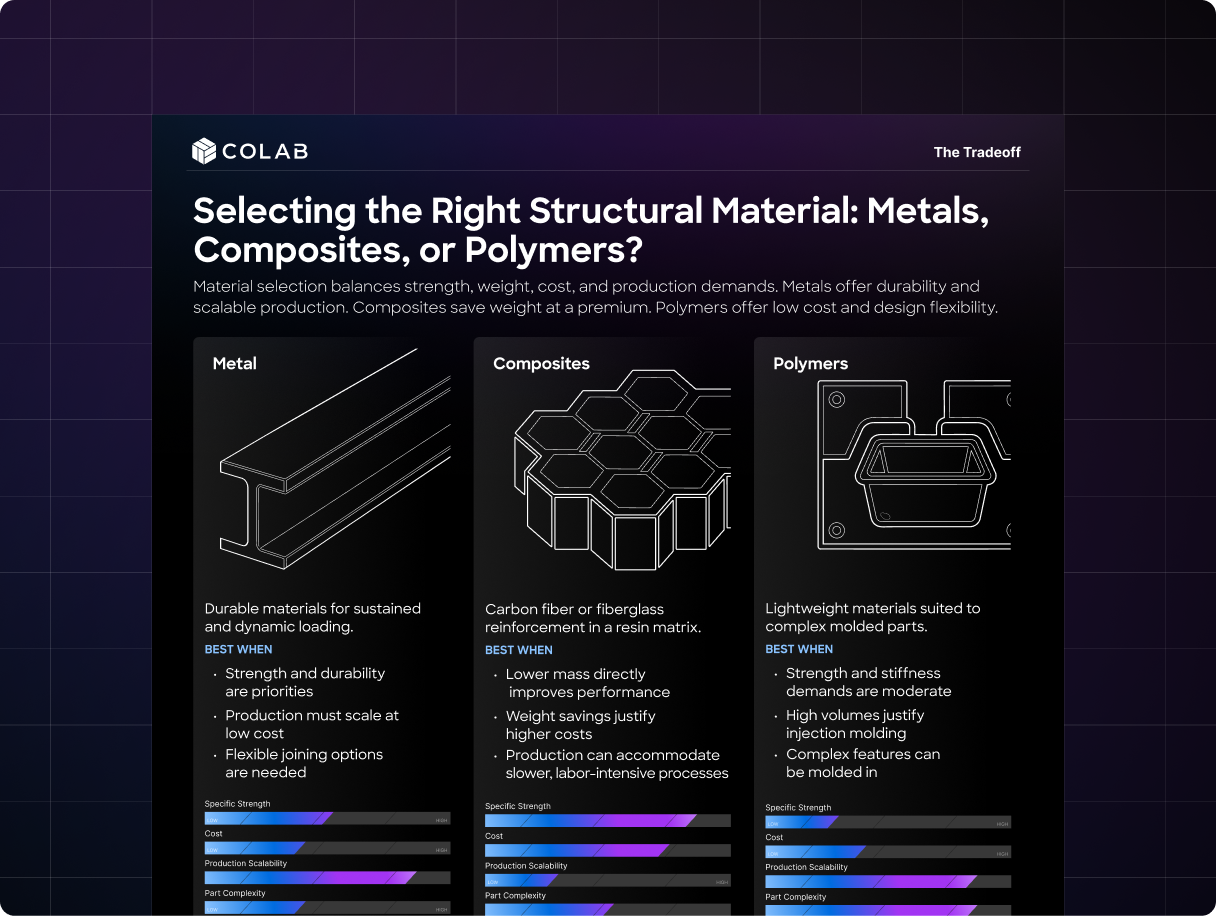
Prefer a visual reference? Download the full structural materials report for the complete comparison.
Metals
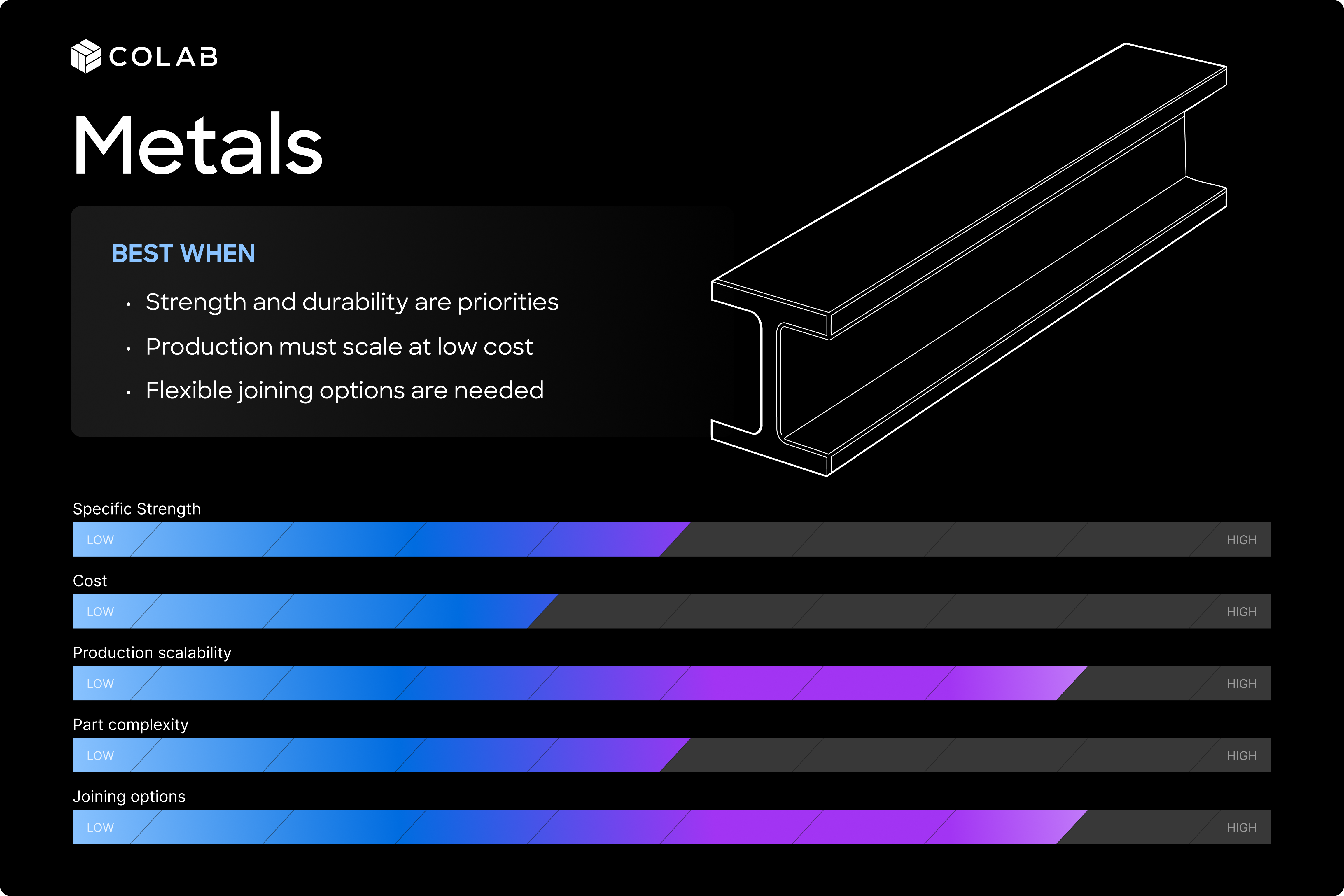
Metals are the most established structural material class in engineering. Their strength and durability under sustained and dynamic loading make them reliable across a wide range of applications, with well-documented material behavior. When metals do fail, they typically yield before fracturing, giving a detectable warning before catastrophic failure occurs.
The main tradeoff is specific strength. Metals can carry significant loads, but they are generally denser than polymers and composites. In applications where mass has a direct impact on performance, that weight can work against the design.
Design freedom depends on the manufacturing process. While CNC machining can produce complex metal parts, stamping, casting, and die casting impose constraints around wall thickness, draft angles, and bend radii—with intricate geometries often requiring additional machining or finishing steps. For straightforward geometries, these constraints are usually manageable.
Read more: The Tradeoff – How To Select The Right Manufacturing Process For Solid Metal Parts
Metals offer the broadest range of joining options, including welding, riveting, bolting, and adhesive bonding. They are also well suited to high-volume production; stamping and die casting are among the fastest, most scalable processes available, keeping per-part cost low once tooling is in place. Raw material cost varies by alloy, but the right process can keep metals cost-effective in many structural applications.
The tradeoff: Metals trade weight and some design freedom for strength, scalable production, and flexible joining options.
Composites
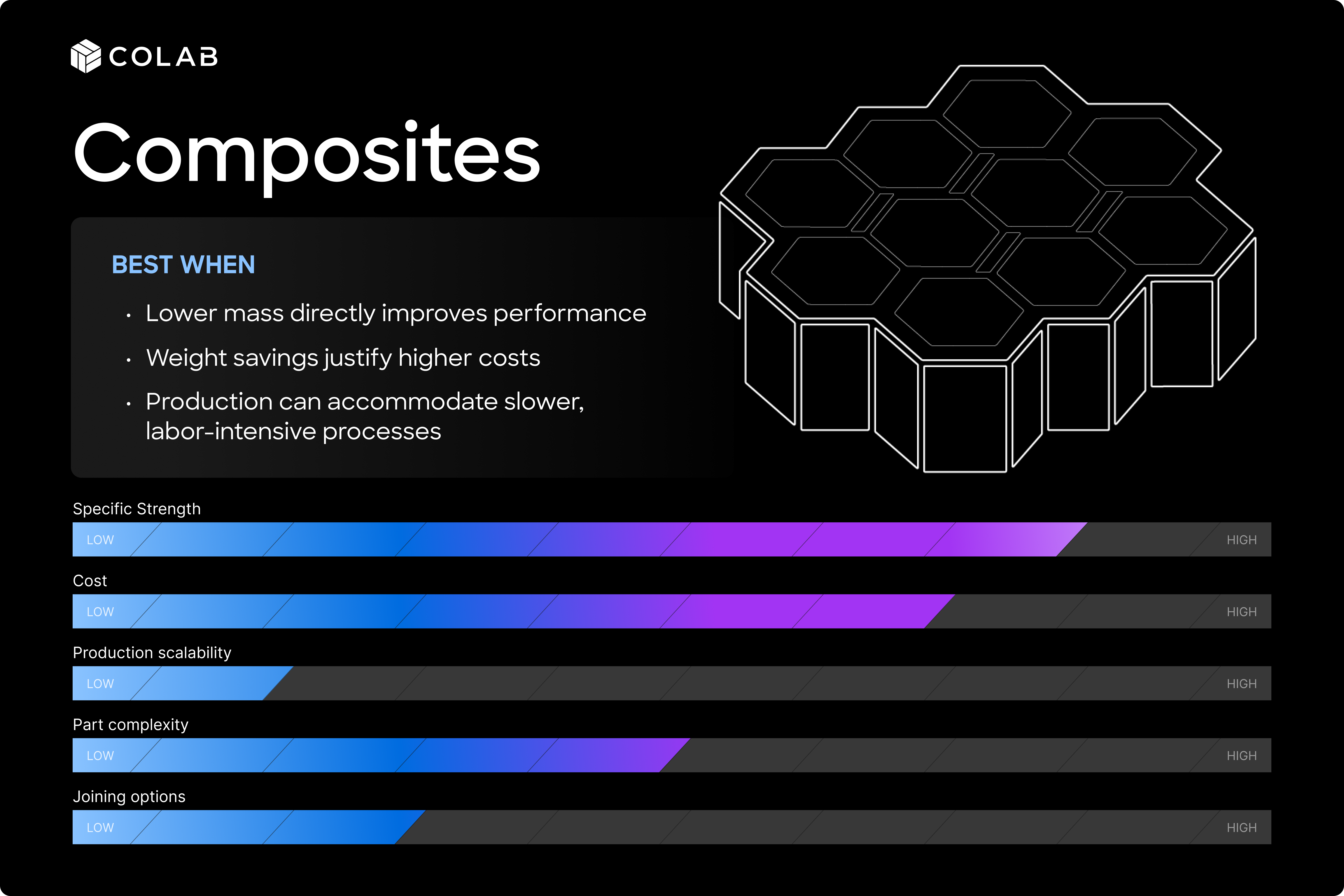
Composite materials combine two or more constituents to produce properties neither could achieve alone. This section focuses on fiber-reinforced polymers used in mechanical components. Carbon fiber and fiberglass are the primary forms, woven into mats and impregnated with an epoxy resin matrix to produce a material that is lighter and stronger than metals on a mass-for-mass basis.
This specific strength makes composites a strong choice where reducing mass has benefits, such as aerospace components and racing vehicles. However, composites are expensive at both the material and process level, so the weight savings need to justify the added cost and complexity.
Composite failure is also characteristically abrupt. Unlike metals, composites do not yield visibly before fracturing, which makes damage harder to detect before it becomes critical.
Design freedom is mixed. Composites can follow complex curves well, but fiber orientation and mold complexity place practical limits during manufacturing.
Composites are poorly suited to high-volume production. They involve slow, labor-intensive processes that do not scale like stamping, die casting, or injection molding. Joining adds another constraint; thermoset composites cannot be welded, so parts must be bonded, mechanically fastened, or both.
The tradeoff: For composites, the tradeoff is cost and production complexity in exchange for exceptional specific strength and controlled, lightweight form.
Polymers
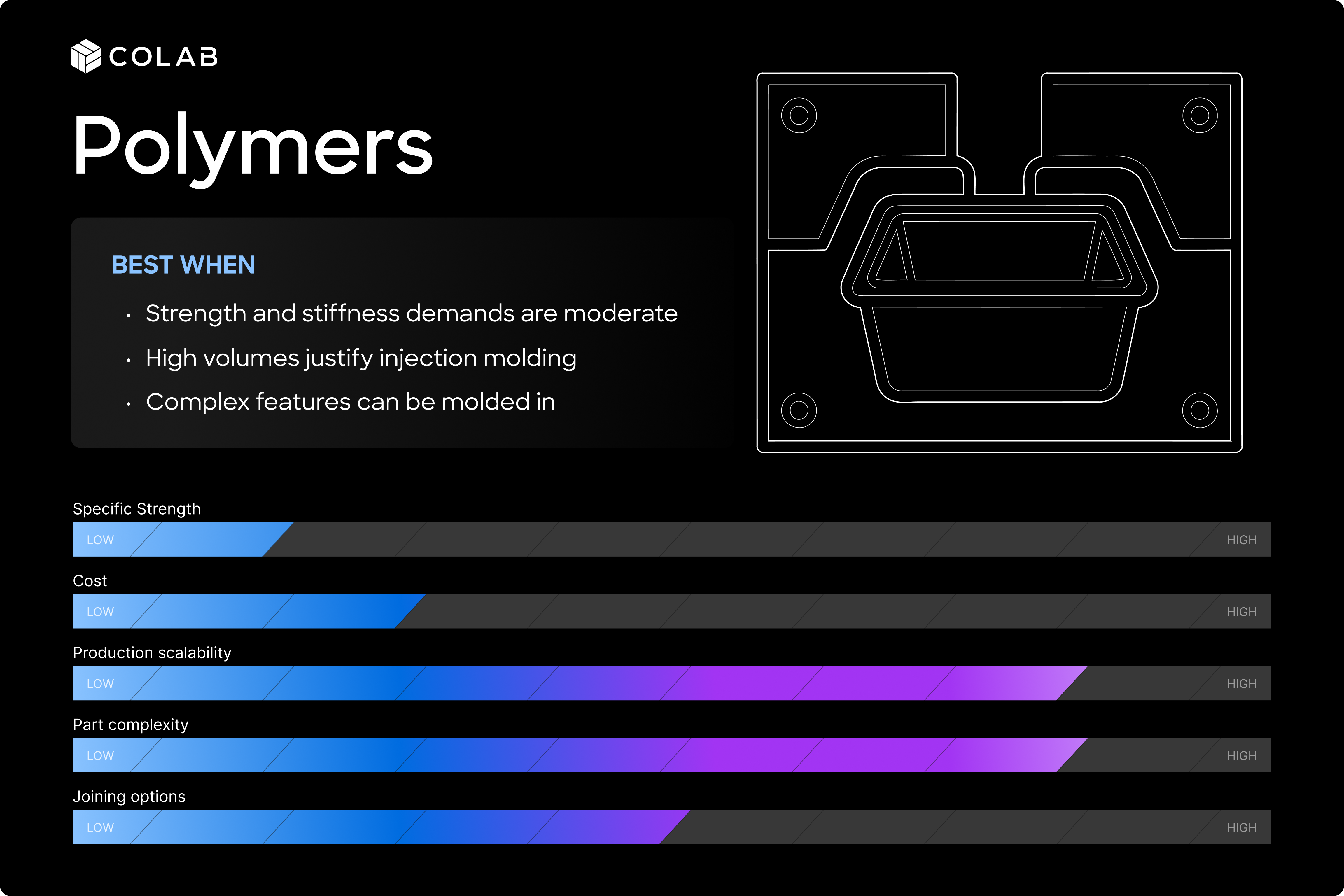
Polymers cover a broad range of materials, falling into two main categories: thermosets, which cure into a permanent rigid structure, and thermoplastics, which can be reheated and reshaped. Across both, stiffness and strength are lower than metals or composites, which makes polymers a poor fit for load-critical parts. Polymers are also susceptible to creep under sustained load and can lose structural stability as temperatures change, in ways that metals and composites do not. For many applications, though, maximum strength is not the deciding factor.
The main advantages of polymers are cost, weight, and design freedom. Injection molding allows features such as ribs and undercuts to be built into the part, reducing the need for secondary operations. It is also purpose-built for high-volume production; once tooling is amortized, fast cycle times and inexpensive raw material can make polymers the lowest-cost option.
Joining options are more limited than metals but more flexible than composites. Thermoplastics can be heat-welded and snap-fit, reducing the need for fasteners in some assemblies. Mechanical fastening is also possible, though less structurally reliable than metal equivalents.
The tradeoff: Polymers trade load-bearing performance for low cost, high production volumes and greater flexibility in part geometry.
Structural material selection in real-world applications
The comparison changes when the requirements of a specific component are considered. A golf club shaft shows when reducing mass can justify a more expensive material. A smartphone housing shows when a polymer can meet the functional requirements with simpler production.
Golf club shafts

Steel was long the standard material for golf club shafts, on account of its durability and cost-effectiveness to manufacture at scale. Carbon fiber composite entered the picture thanks to its influence on the physics of the swing.
A composite shaft delivers comparable or greater stiffness at significantly lower weight, enabling faster swing speeds and more precise energy transfer at impact. The layup process can also be tuned to achieve specific flex profiles and torque characteristics that are difficult to replicate in steel. However, composite shafts require more expensive materials and do not scale well to high-volume production.
Tradeoff: Steel remains a legitimate choice where cost and durability are the primary criteria. When performance matters and the application can absorb the cost premium, carbon fiber composite is the stronger alternative.
Smartphone housings

Early smartphones commonly used polycarbonate housings. As the market matured, many flagship devices moved to aluminum unibody construction because it offered greater durability and a rigid metallic feel that polycarbonate lacked. Nevertheless, polymer housings are still being used in other devices.
Engineering-grade polymers can provide enough strength for a phone housing while keeping the part lighter and less expensive to produce at volume. Injection molding also allows tighter integration of antenna windows or internal mounting features within a single part. With aluminum, those same requirements translate to additional machining or assembly steps.
Tradeoff: Aluminum still has the advantage when heat dissipation and impact durability are priorities. Where those demands are moderate, polymers can meet the functional need with simpler production and more flexibility in part geometry.
Choose the material and manufacturing process together
The material choice affects both the finished part and the process used to make it. A reduction in mass is useful when it improves performance enough to justify the cost. Production volume, part geometry, and joining requirements determine whether that choice is practical to manufacture.
Metals offer strength and durability with established production and joining methods. Composites become attractive when specific strength is worth the added cost and production complexity. Polymers can reduce cost and simplify production when their mechanical and thermal limits are acceptable. The application determines which tradeoff makes sense.
Record the required performance, expected production volume, alternatives considered, and reason for the selection. If the load, volume, or cost target changes, that record gives the team a basis for revisiting the decision.
Decisions are the atomic unit of engineering. The material specification captures one of those decisions. Preserving the reasoning behind it gives the next engineer or program a useful starting point.
Make the rationale part of the design record
CoLab gives engineering teams one place to review technical data, discuss tradeoffs, resolve feedback, and capture the context behind design decisions. See how CoLab helps teams make better design decisions, faster.
This is the third of six installments of The Tradeoff. Up next: selecting the right mechanical fastener. Subscribe below to get the next installment when it is published.
Subscribe to get notified when new installments of The Tradeoff are released


About the author
Nathan Power is a Mechanical Engineer at CoLab with hands-on experience taking mechanical systems from prototype to production across robotics, industrial automation, 3D printing, and automotive applications.