How To Select The Right Manufacturing Process For Solid Metal Parts




Say you're a design engineer in the final concept design stage for a new product and you’re asked: how should we manufacture this part?
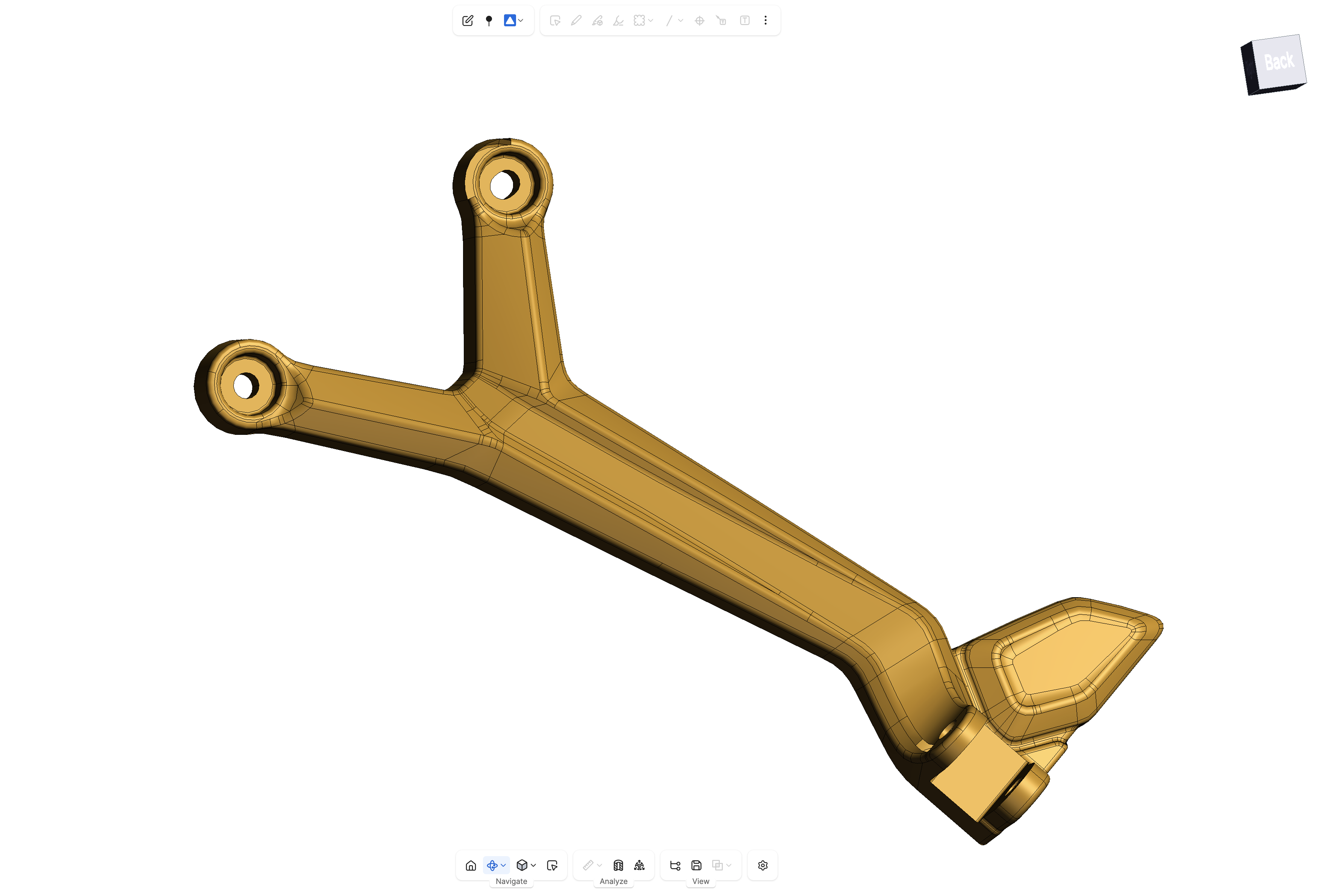
Obviously, you’d have questions. More context is required to make this decision. You’d probably ask which loads will it carry, and in which directions? Is the governing requirement strength, stiffness, weight, corrosion, wear, cost, or something else? How many need to be made? And, of course, what is it and what is it part of?
It doesn’t take much digging to reveal the complexity. What looked like one decision is really several, and the right path forward depends on how each one resolves.
That's true of most calls an engineer makes. They look routine until you pull on them. To complicate things further, few have a single correct answer; often there are multiple viable options. In those scenarios, the choice comes down to the tradeoffs between them.
Introducing: The Tradeoff
Today we’re launching The Tradeoff, a brand new content series in partnership with Engineering.com. Each installment explores a decision commonly encountered in engineering programs and provides a practical, visual way of comparing the options and making the right call.
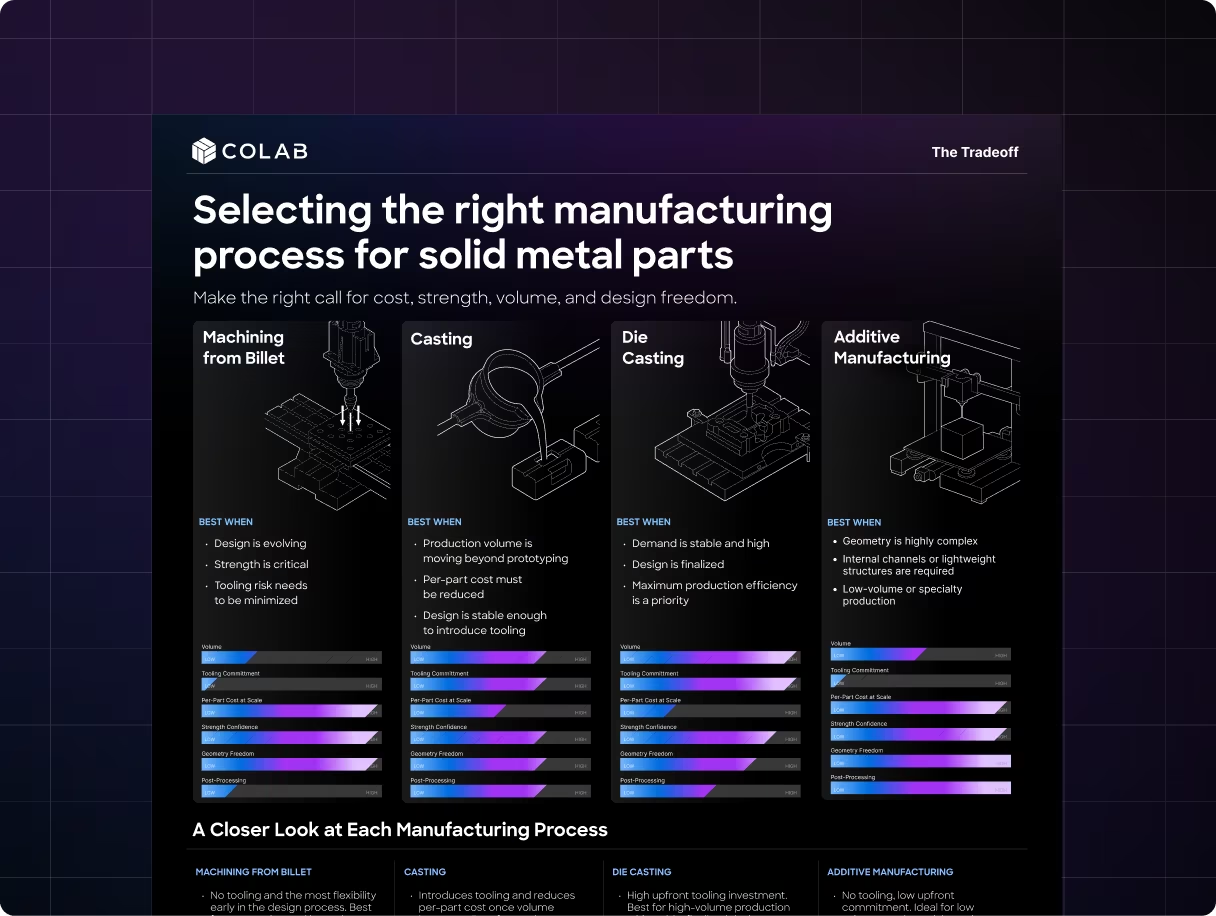
The first installment compares four common ways to manufacture a solid metal part: machining from billet, casting, die casting, and additive manufacturing. It covers when machining makes economic sense (and when it doesn’t), whether casting is worth the tooling investment, where additive manufacturing adds the most value, and more. There are also multiple formats of this content available, meaning you can consume it in a way that suits you best.
Selecting the right manufacturing process for a solid metal part
When deciding how a solid metal part should be made, I’m sure you can think of a dozen angles of inquiry without much effort at all. The good news is that for solid metal manufacturing, the options are for the most part grouped into four main categories:
- Machining from billet
- Casting
- Die casting
- Additive manufacturing
Let’s explore each option in more detail; where they excel and where they fall down, which factors to consider before you commit, and what tradeoffs to make along the way.
Machining from billet
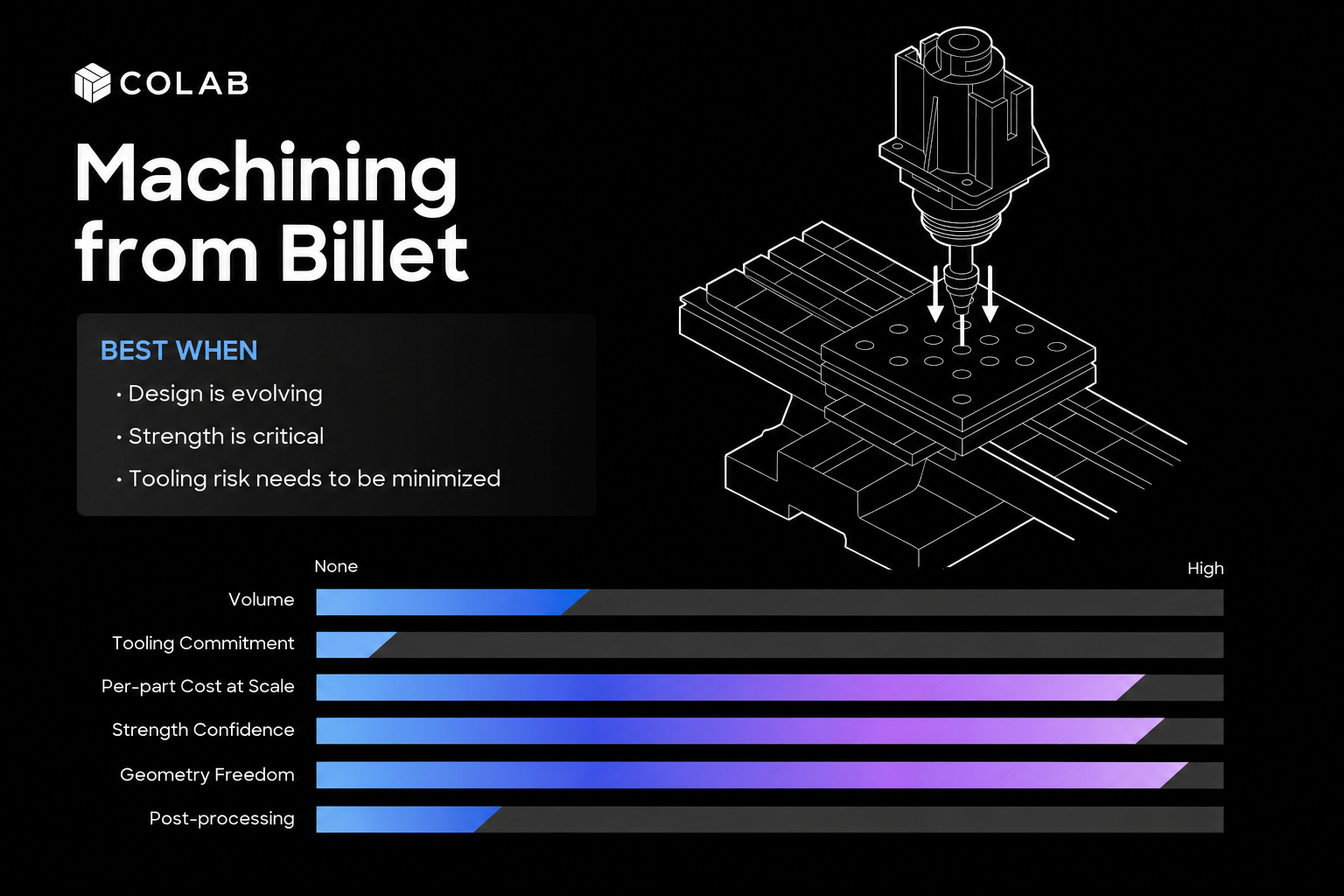
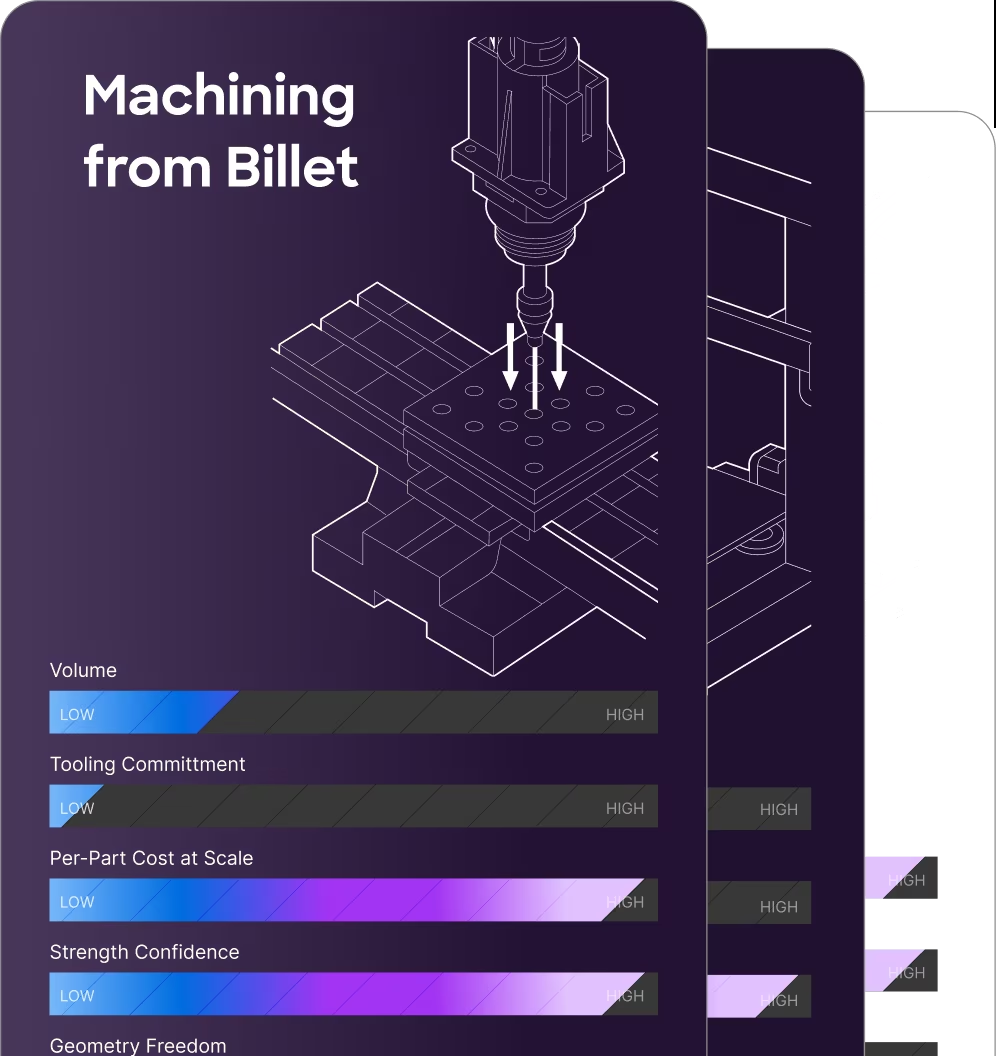
Machining from billet requires no tooling and offers the most flexibility early in the design process. It is best suited to prototyping and low production volumes. Parts can be iterated quickly, tolerances are tight, and material properties are consistent. For load-bearing parts where strength in critical areas matters, machining provides higher structural confidence because it is cut from solid stock and avoids porosity-related risk.
Machining also gives engineers more freedom in geometry. It handles sharp external edges and variable wall thickness well. Internal corners are the exception. Because internal corners are limited by the tool radius, a sharp internal corner requires a secondary operation such as EDM or broaching. In many cases the machined part is close to finished as soon as it comes off the CNC machine, however some post-processing such as deburring, cleaning, passivation, or tumbling is usually required.
The tradeoff is cost and efficiency. Cycle times are longer and per-part cost stays relatively high as volume grows, partly because material is removed as waste. Teams often begin to consider a transition in the middle ground where volumes are too high for prototype machining but too low to justify hard tooling.
The Tradeoff: Machining from billet minimizes tooling risk and delivers strong, precise, quickly iterable parts. It trades that flexibility for longer cycle times, higher material waste, and higher per-part cost as volume grows.
Casting
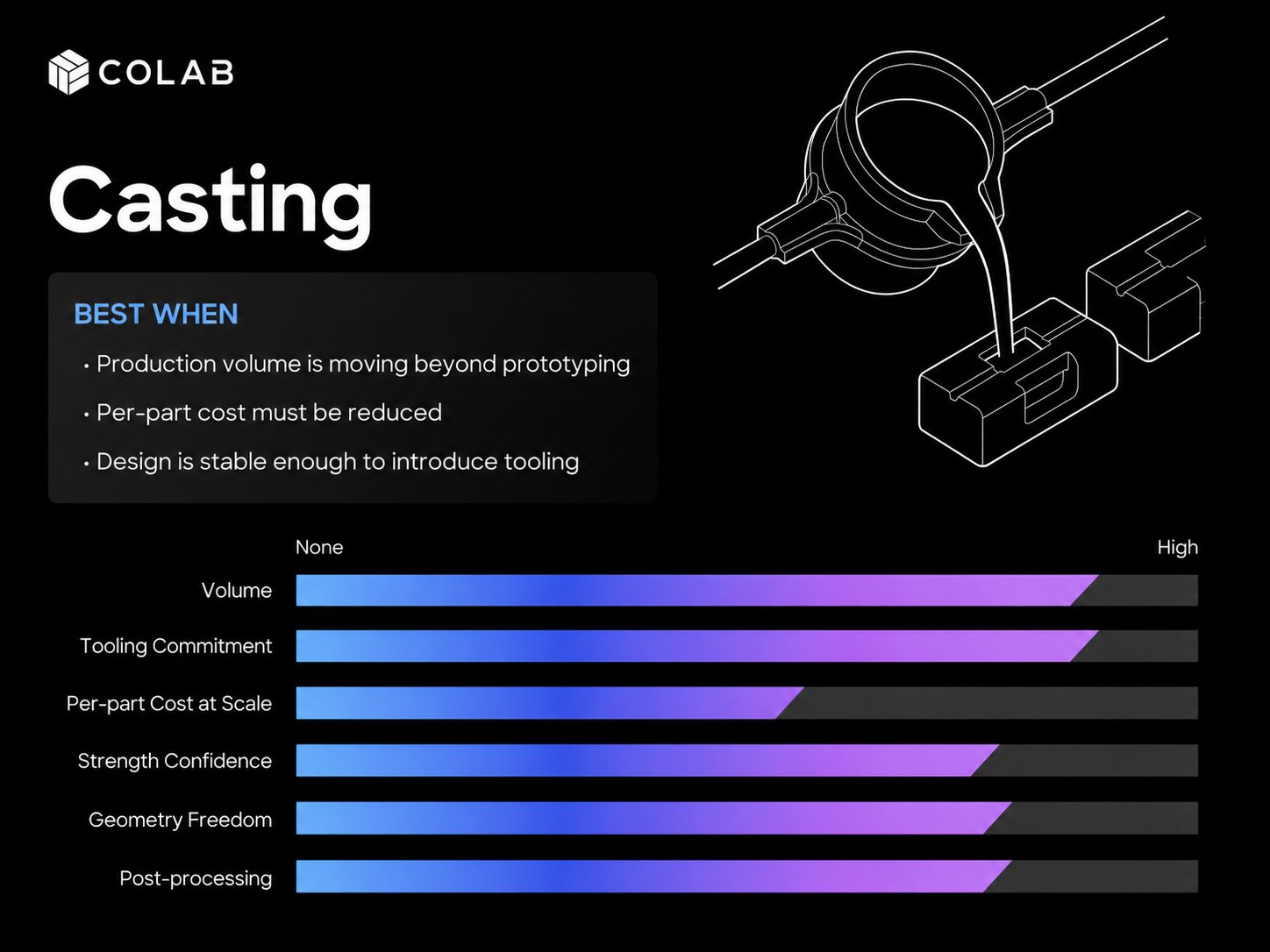
Casting introduces tooling, but reduces per-part cost once production volume increases. Material utilization improves and cycle times drop compared to machining. It is best suited for moderate production volumes when cost pressure begins to outweigh the flexibility of machining. The shift to casting usually occurs at a threshold that depends on geometry, material, tolerances, and confidence in future demand. The decision often comes before volume is fully guaranteed, which makes the commitment more difficult.
Casting typically produces a near-net shape part that requires secondary machining operations. It also introduces design constraints. Wall thickness must be controlled, and draft angles are required. Features such as ribbing are frequently introduced to meet casting requirements. If these constraints are identified late, redesign is often necessary.
Porosity risk depends on geometry and process control. It is not uniformly distributed and can become a concern in load-bearing regions or thin sections. A part may perform well in most areas and still fail due to a localized defect. For non-structural parts, this risk may be acceptable. In structural applications requiring strength in critical areas, the tradeoff must be evaluated carefully.
Casting is often the first step away from machining as volume increases and the design begins to stabilize, even if demand is not yet fully stable. It reduces per-part cost without the full tooling commitment associated with die casting.
The Tradeoff: Casting trades upfront tooling investment and fixed design constraints for lower per-part cost, better material utilization, and faster cycle times at volume.
Die casting
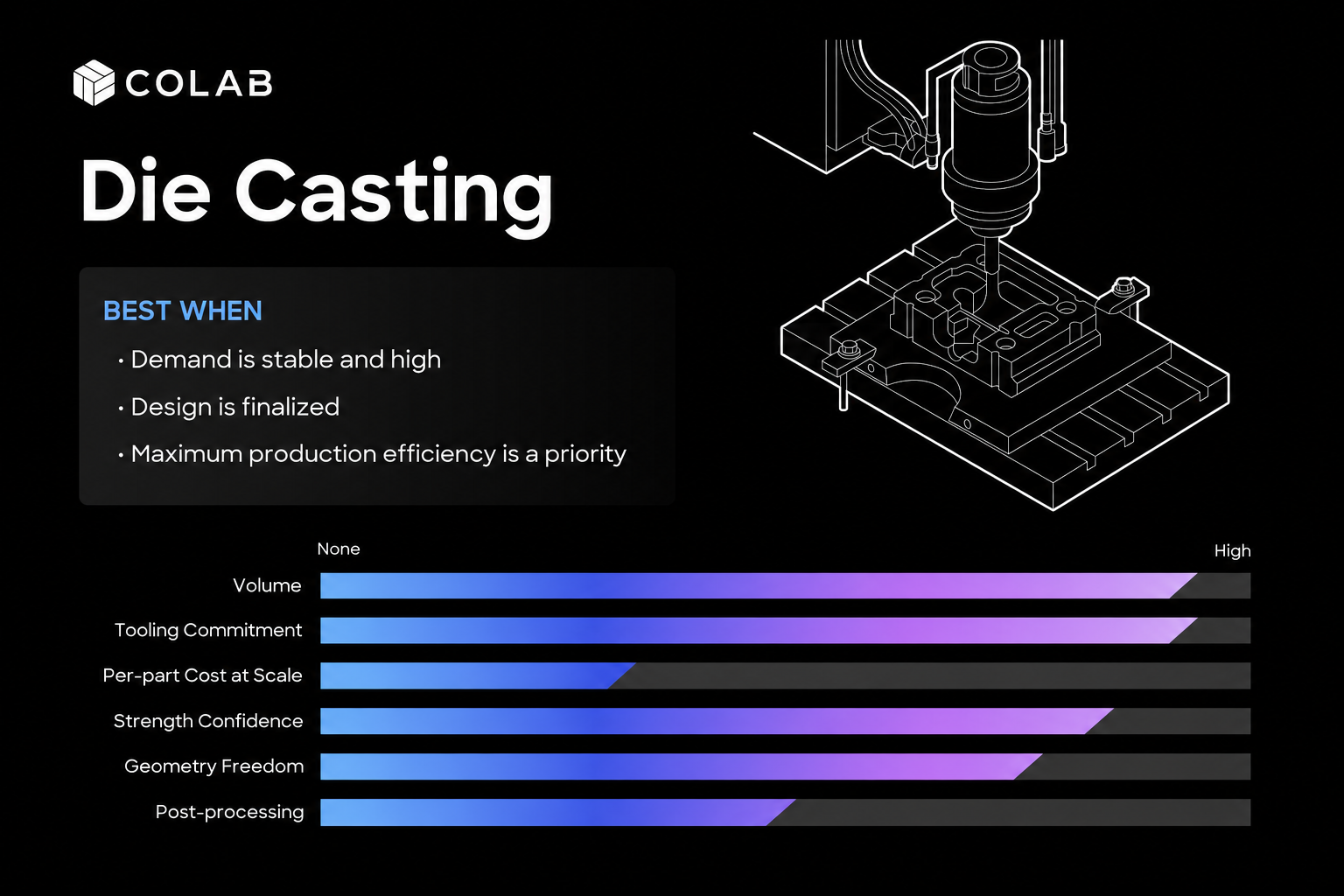
Die casting requires significant upfront tooling investment, and is selected when demand is stable and the design is largely finalized. It is best suited for high-volume production, delivering short cycle times.
Compared to casting, tooling is more expensive and specific, and design changes are costly once the tool is cut. Committing too early can lead to sunk cost if volumes do not materialize or if designs change, which is why teams choose die casting when they are confident the volume will justify the investment.
Die casting is most commonly used with materials such as aluminum and zinc alloys. Steel is not typically die cast, so material choice can narrow the available process options.
Like casting, die casting imposes geometric requirements such as draft angles, controlled wall thickness, and ribbing. While die casting generally achieves tighter tolerances than conventional casting, post-processing is still required. Flash must be trimmed, and parts undergo selective machining.
Die casting can reduce porosity risk compared to casting because the metal is injected under high pressure rather than relying on gravity fill. As a result, die cast parts offer higher strength confidence than casting, though performance still depends on process control and geometry.
Die casting offers the least flexibility of the methods discussed, but the payoff is repeatability.
The Tradeoff: Die casting trades high upfront tooling cost, narrowed material options, and reduced design flexibility for the shortest cycle times, lower porosity risk, tighter tolerancing, and lowest per-part cost at high volume.
Additive manufacturing
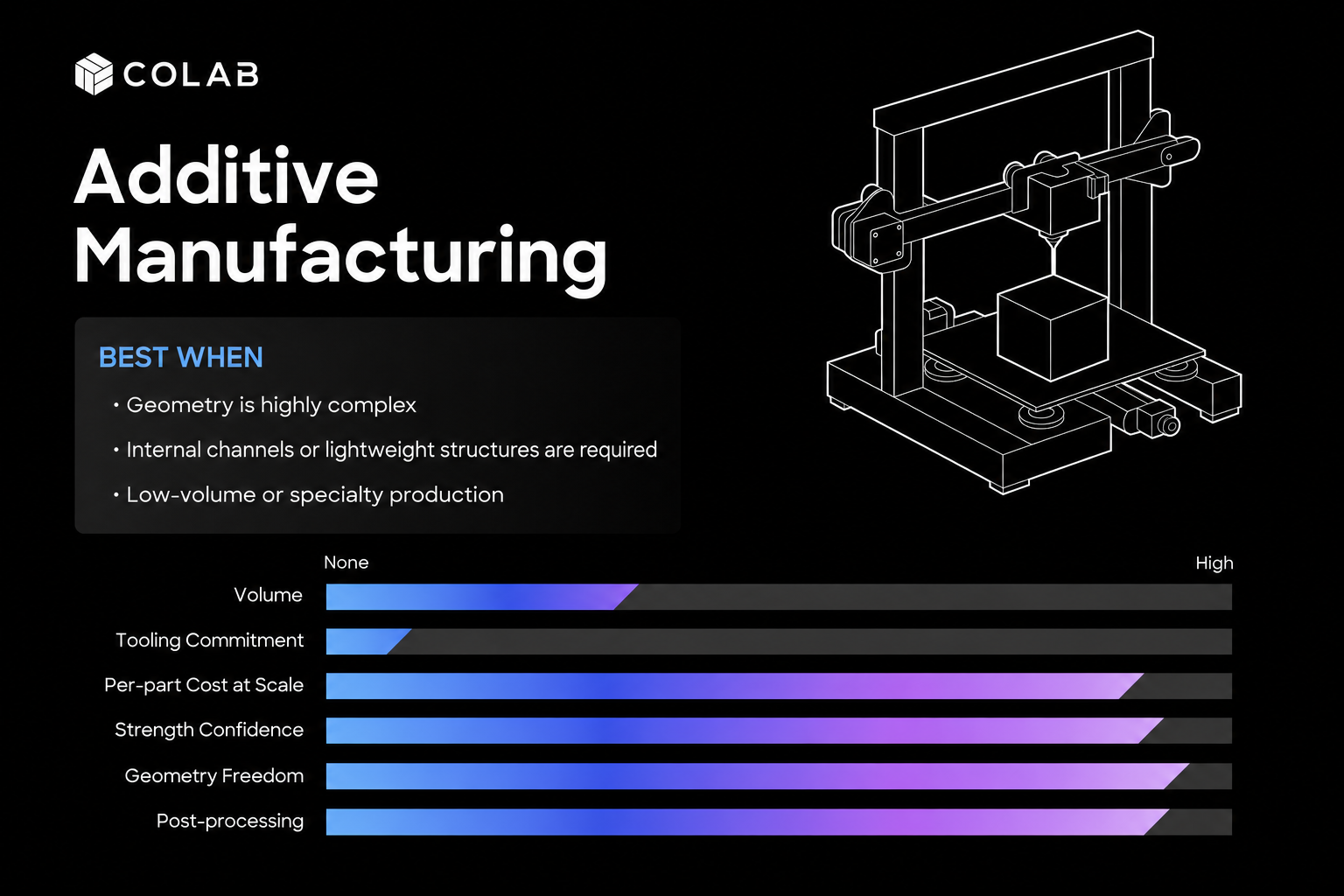
Like machining, additive manufacturing requires no tooling. This reduces upfront commitment and makes additive well suited for low production volumes and specialty variants.
Additive supports highly complex geometries, including closed internal channels and lightweight structures that cannot be produced by other processes. If done properly, additive parts can be fully densified and offer material properties comparable to machined parts.
However, parts come off the machine with rougher surface finish and often include support structures that must be removed. Heat treatment, surface finishing, and secondary machining are typically required.
Additive is not optimized for high-volume production, and per-part cost remains relatively high. It may make sense for a few hundred specialty automotive components annually, but it is unlikely to replace die casting for parts produced in the tens of thousands.
The Tradeoff: Additive manufacturing trades no-tooling flexibility and unmatched geometric freedom for rougher surface finish, added post-processing, and per-part costs too high for high-volume production.
Manufacturing process selection for real-world applications
Understanding the differences between solid metal part manufacturing processes becomes simpler once the tradeoffs are laid out. Selecting and committing to a process for real components raises the stakes.
The following examples illustrate how the decision framework applies to actual components in real-world applications, and how the context, constraints, and lessons learned from previous product cycles informed the ultimate decision.
Motorcycle sump: volume-driven process change
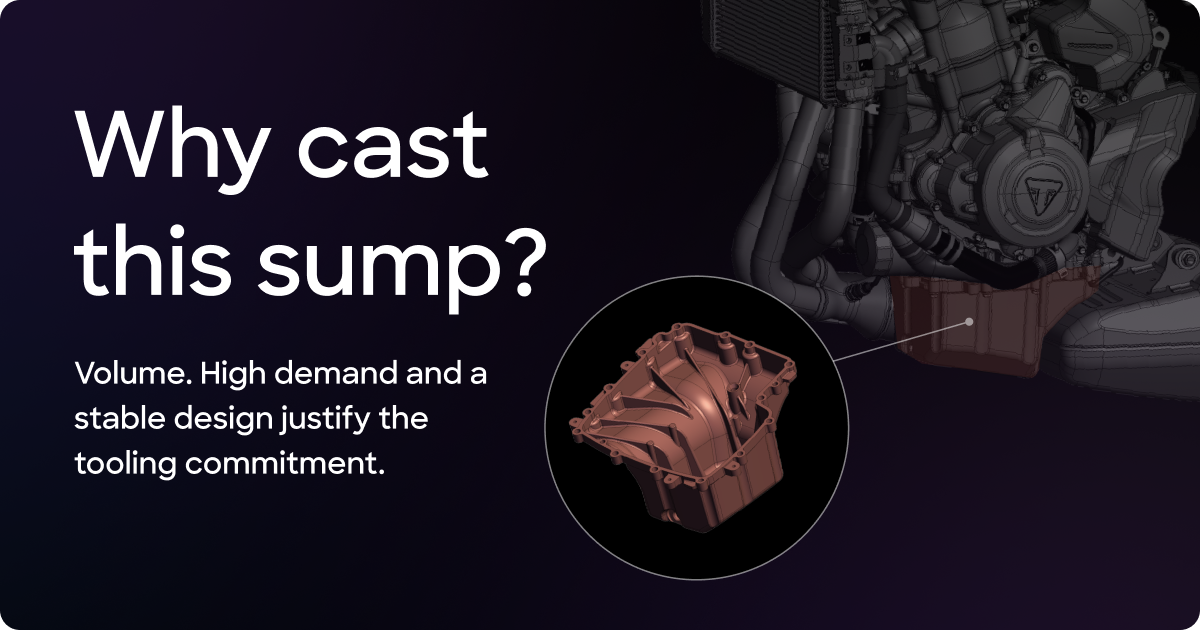
At low production volumes, this sump would be machined from billet aluminum to avoid tooling cost while preserving flexibility during early development. As volume increases, investing in tooling for casting reduces cycle time and material waste, lowering per-part cost. The design is adjusted to meet casting requirements.
Decision: In this case, volume drives the decision. Once demand justifies tooling investment, casting becomes the appropriate choice.
Rear footrest bracket: when strength overrides cost
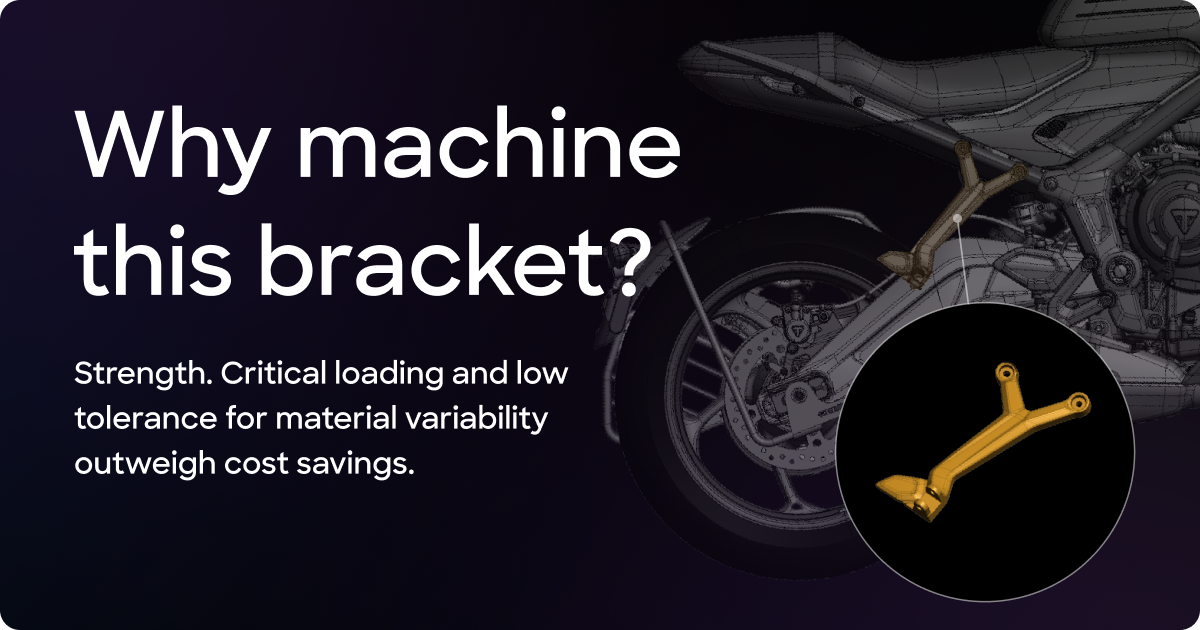
Finally, we meet our part example from the top of the post. It’s a rear footrest bracket from a Triumph motorcycle.
The bracket operates in a high-vibration, load-bearing environment. In testing, the part cracked under tip-over simulation (see the lesson learned noted in the image below). Analysis showed stress concentrations in areas that could not tolerate material variability. This part, when manufactured from casting, did not have the structural integrity that was required and would more likely be present in a machined part.
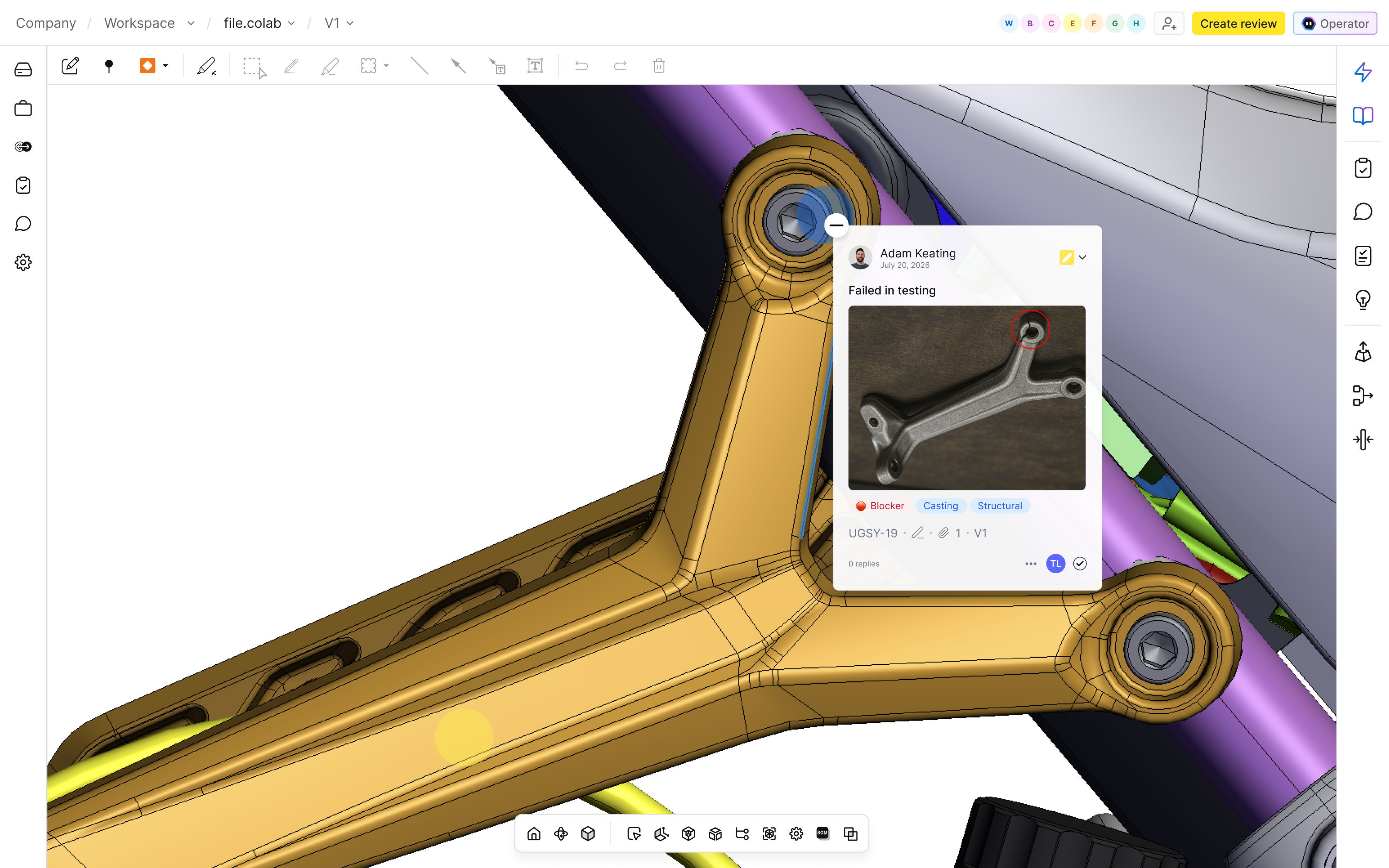
Decision: Machining from billet would provide greater structural confidence and more consistent material properties. For components operating in critical load paths, strength outweighs cost savings. In this scenario, the correct design decision would be to specify machining rather than casting.
Decisions are the atomic unit of engineering
Engineers make tens of thousands of decisions over the course of an NPD cycle. Choices that seem simple at first can rapidly spiral in complexity once the constraints, historical context, lessons learned, volume, timeline, and numerous other conditions of a program are factored in.
What’s more, for many of those decisions there’s no single correct answer; there are multiple viable paths. The call you make ultimately comes down to comparing the tradeoffs between the options available to you.
Manufacturing solid metal parts is one such example. There are many different ways to fabricate a metal component, and there are advantages and disadvantages to each approach. The tradeoffs need to be carefully considered before committing to an approach.
That’s the idea behind The Tradeoff.
This is the first of six installments where we do a deep dive into a common yet consequential design decision. Up next, which actuation method is best for specific applications? To find out, and be notified when the next installment is published, sign up below.
Subscribe to get notified when new installments of The Tradeoff are released

About the author
Nathan Power is a Mechanical Engineer at CoLab with hands-on experience taking mechanical systems from prototype to production across robotics, industrial automation, 3D printing, and automotive applications.