How to Select the Right Actuation Method




Actuation is the process of putting a machine, device, or system into motion. An actuator is a machine component that converts energy into physical, controlled mechanical work. There are different types of actuators, each with different capabilities and characteristics, grouped by power source and the type of movement they make. This article compares three actuation methods: electric, which converts electrical energy into precise mechanical motion; hydraulic, which uses pressurized liquid to move heavy loads with huge force; and pneumatic, which uses compressed gas to create simple, fast movement. Actuators can create linear (straight line) or rotary (circular or rotational) movement.
For a mechanical design engineer, selecting an actuation method means matching the actuator to the machine’s requirements. The required motion, force, control precision, duty cycle, available infrastructure, operating environment, and maintenance requirements all shape the decision. Electric, hydraulic, and pneumatic actuators all satisfy those constraints differently. The choice is a tradeoff.
That decision is the focus of the second installment of The Tradeoff. The first installment compared four ways to manufacture a solid metal part. This installment compares where electric, hydraulic, and pneumatic actuation fit and the tradeoffs involved in selecting the right method for your application.
How to choose the right actuation method: start with the system
The surrounding system often narrows the options before an actuator is selected. A useful comparison starts with five questions:
- Force density: How much force must the actuator deliver, and how much space is available?
- Control: Does the application require precise positioning and repeatability, or simple movement between preset positions?
- Duty cycle: How frequently will the system move, for how long, and under what load?
- Infrastructure: Are electrical power and controls, hydraulic power, or compressed air already available?
- Operating environment: How important are cleanliness, energy efficiency, temperature, air quality, and maintenance access?
This is the same principle behind an effective engineering design review: define the decision and the evidence needed before evaluating the options.
At a glance, the three methods compare this way:
- Electric actuation: Medium force density and high control precision, with low maintenance and infrastructure requirements. Best suited to precise, repeatable motion in systems with electrical power and controls.
- Hydraulic actuation: High force density and medium control precision, with high maintenance and infrastructure requirements. Best suited to heavy, load-bearing work that requires high force in a compact package.
- Pneumatic actuation: Low force density and control precision, with medium maintenance and high infrastructure requirements. Best suited to simple, fast, repetitive motion where compressed air is already available.
Prefer a visual reference? Download the full actuation methods report for the complete comparison.
Electric actuation
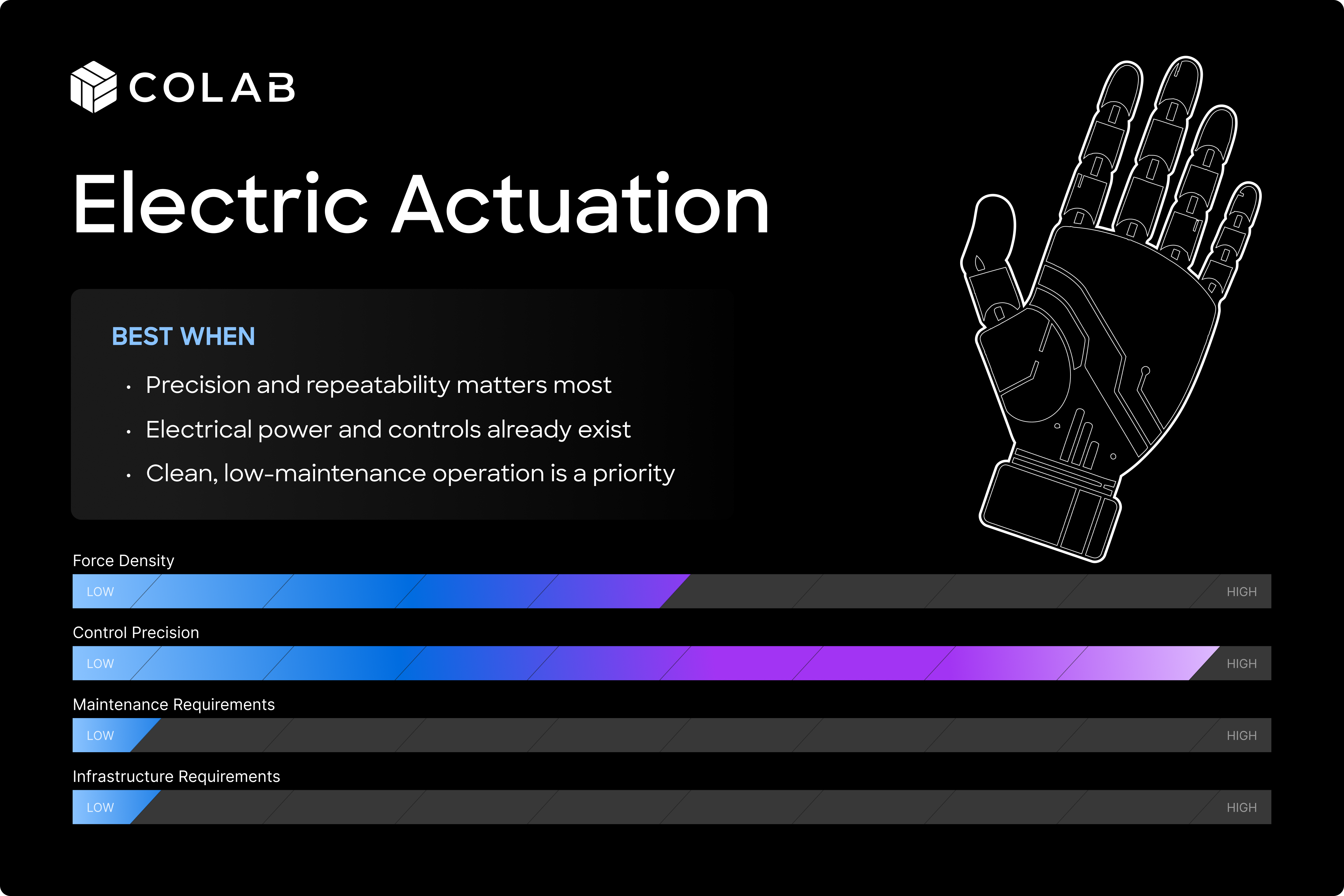
Electric actuation uses electrical power to create motion through motors. It is usually the strongest option when precision, control, and repeatability are the priority.
When electrical power and controls already exist elsewhere in the system, an electric actuator can be integrated through wiring without adding the pumps, compressors, or fluid lines needed for hydraulic or pneumatic actuators. Its favorable strength-to-weight ratio can also make it attractive in weight-conscious applications such as mobile robots.
Electric actuation is generally cleaner and lower-maintenance than fluid-based systems. There are no hoses, seals, or working fluids to manage, and no risk of fluid leakage. That makes electric systems useful where contamination is a concern. Electric actuation is also typically the most energy-efficient of the three options, particularly in mobile or battery-powered systems.
It can be a strong fit for frequent, repeatable motion, although the duty cycle still has to be evaluated for the specific application. If a system must operate continuously under heavy load, hydraulics may be more advantageous.
The tradeoff: Electric actuation gives up maximum force density in exchange for greater precision, cleaner operation, lower maintenance, and easier integration.
Hydraulic actuation

Hydraulic actuation uses pressurized fluid to create motion through cylinders or hydraulic motors. Its primary advantage is force density. A hydraulic system can deliver high output from a relatively compact actuator, making it a strong option for heavy, load-bearing applications. It can also perform well in systems that cycle frequently over long periods.
That force comes with added system complexity. Hydraulic actuation depends on pumps, reservoirs, hoses, and seals, so it usually makes the most sense when hydraulic power already exists elsewhere in the system or when the force requirement is high enough to justify the infrastructure.
Hydraulic systems also require more maintenance over time. Fluid handling, seal wear, and the possibility of leaks all become part of the decision. Those demands may be acceptable in rugged, heavy-duty environments, but they can make hydraulics less attractive where clean operation and simple maintenance are priorities.
The tradeoff: Hydraulic actuation delivers the highest force density of the three methods, but requires more infrastructure, fluid management, and maintenance.
Pneumatic actuation

Pneumatic actuation uses compressed air to create motion through linear or rotary actuators. It is commonly used for simple, fast, repetitive movement in fixed industrial settings. It becomes especially practical when compressed air is already available, because the main infrastructure is in place.
Many basic pneumatic systems move between preset positions rather than providing continuous position control. That makes them well suited to straightforward, repeatable motion, but less suitable for applications that demand precise positioning. Pneumatic actuation also offers lower force density than hydraulics, so hydraulics become the stronger option when very high force must fit into a compact package.
Like hydraulics, pneumatics require supporting infrastructure, including compressors, valves, fittings, and air lines. Maintenance requirements are usually lower than for hydraulics, but they are still present. Pneumatic actuation is also the least energy-efficient of the three methods because energy is lost while air is compressed and distributed, as well as through leaks and pressure drops. Moisture, air quality, and temperature can also affect system performance.
The tradeoff: Pneumatic actuation prioritizes fast, simple, repeatable motion over precise positioning, maximum force density, and energy efficiency.
Actuation method selection in real-world applications
The rating framework establishes the broad differences between the three methods. Real applications show how one or two system constraints can decide the outcome.
Cobot end effectors: when the default changes
A cobot end effector, such as a robot gripper used to pick and place parts, shows how actuator choices can shift as technology changes.

Pneumatic grippers were widely used because they were relatively inexpensive, simple to design, and able to provide the required gripping force when electric options were bulkier, more expensive, and more limited in output. In fixed industrial settings, existing compressed-air infrastructure also made pneumatics straightforward to implement.
Higher-torque motors and linear electric actuators have changed that comparison. For many light- to medium-duty gripper applications, electric actuation now provides sufficient force along with lower maintenance, simpler wiring, and better energy efficiency. Pneumatic grippers remain common for heavier payloads, especially where compressed air is already available or can also support functions such as vacuum generation and short air bursts.
Decision: Electric actuation is now a strong fit for many light- to medium-duty grippers. Pneumatics remain viable when payload or existing air infrastructure shifts the balance.
Press brakes: when force sets the floor
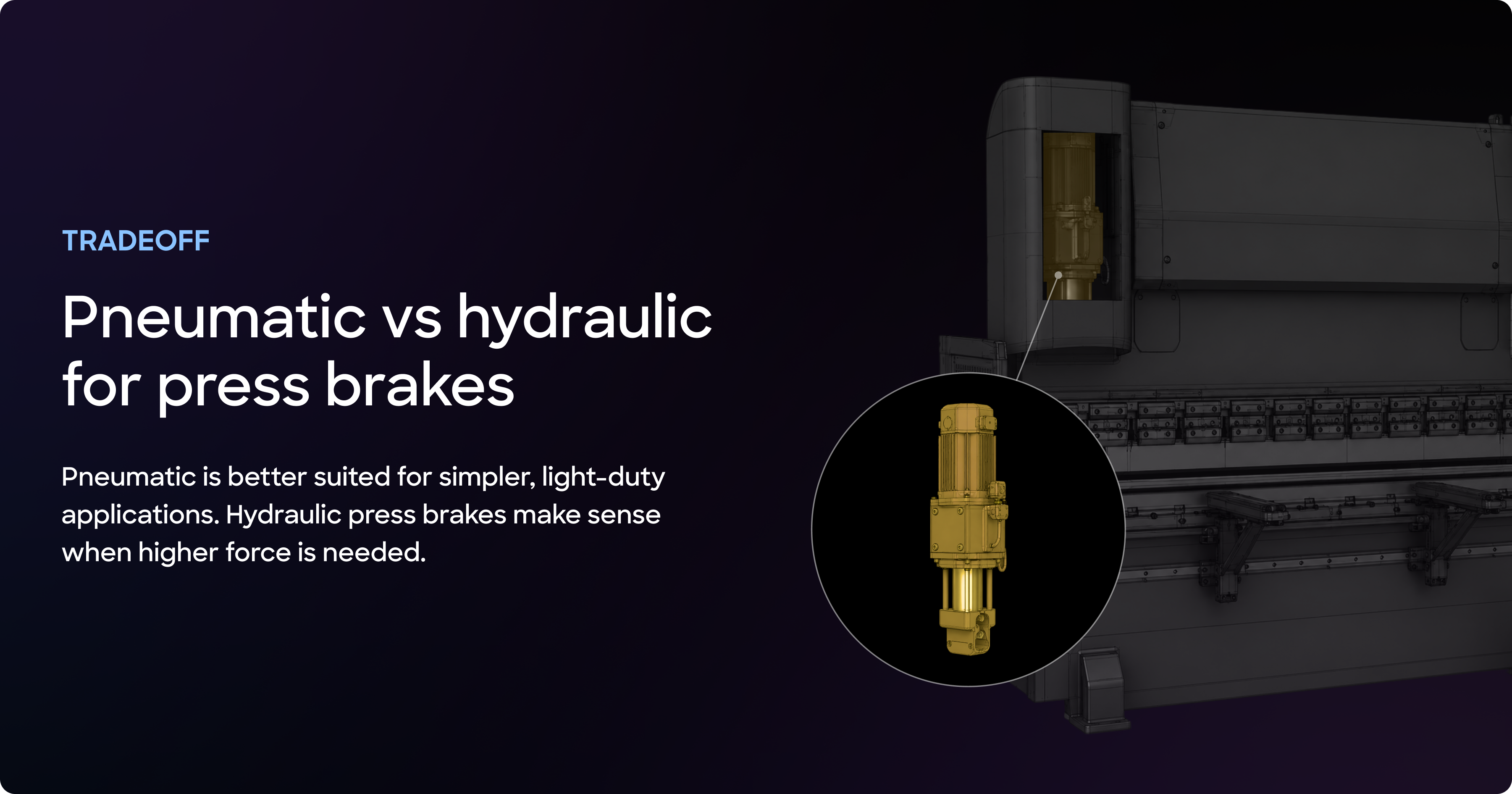
A press brake used to bend sheet metal illustrates the tradeoff between hydraulic and pneumatic actuation. Both methods can perform similar bending operations, but the better choice depends on the required force, the size of the machine, and the needs of the application.
Pneumatic press brakes are generally better suited to lighter-duty work where lower cost and simpler operation are the leading constraints. Hydraulic press brakes make sense when significantly more force is required. In some high-force applications, hydraulics may also be the safer choice because very high-pressure compressed air can introduce additional risk.
Decision: Pneumatic actuation fits lighter-duty bending when cost and simplicity matter most. Hydraulic actuation becomes the better choice as force requirements climb.
The right method is the one that fits the full system
Actuator selection does not stop at the actuator. The choice affects the system's controls, packaging, energy use, maintenance plan, operating environment, and supporting infrastructure.
Electric actuation is usually the strongest fit when precision, cleanliness, and integration matter most. Hydraulics make high force possible in a compact package when the supporting complexity is justified. Pneumatics keep simple, repetitive motion practical when compressed air is already part of the environment.
No option is universally correct. The right answer emerges when the team makes the constraints explicit, compares the viable options, and records why the selected tradeoff fits the application.
Decisions are the atomic unit of engineering. An actuation choice is one of many context-dependent calls that shape the product and the program around it. The same decision, or one very much like it, will surface again on another component or program. Preserving the reasoning gives the next team a better starting point than the final selection alone.
Make the rationale part of the design record
CoLab gives engineering teams one place to review technical data, discuss tradeoffs, resolve feedback, and capture the context behind design decisions. See how CoLab helps teams make better design decisions, faster.
This is the second of six installments of The Tradeoff. Up next: selecting the right structural material. Subscribe below to get the next installment when it is published.

Subscribe to get notified when new installments of The Tradeoff are released

About the author
Nathan Power is a Mechanical Engineer at CoLab with hands-on experience taking mechanical systems from prototype to production across robotics, industrial automation, 3D printing, and automotive applications.