
Talk to a product expert
AI for PLM in Engineering


AI for PLM in discrete manufacturing refers to the application of machine learning, generative AI, and intelligent agents to engineering data stored in systems like Siemens Teamcenter, PTC Windchill, and ENOVIA (including 3DEXPERIENCE ENOVIA). Unlike process PLM environments used in food, cosmetics, or specialty chemicals, discrete manufacturing PLM systems manage CAD assemblies, multi-level BOMs, engineering change orders, technical drawings, and requirements across automotive, aerospace, industrial equipment, and medical device organizations.
That distinction matters. Because the data is different, the AI strategy must be different.
Much of the existing content about “AI in PLM” focuses on regulatory workflows and document automation. But in discrete manufacturing, AI is being applied to geometry, part relationships, change processes, and design validation. The opportunity looks fundamentally different.
This article breaks down what AI in PLM actually means for engineering organizations today, how adoption is unfolding inside Teamcenter and Windchill environments, and why the most strategic leaders are thinking beyond PLM itself.
AI for discrete PLM vs. AI for process PLM
Not all Product Lifecycle Management (PLM) systems are built the same. Discrete PLM platforms focus on manufacturing processes where units are assembled – and can be counted and tested separately (e.g. automotive, industrial equipment, medical and consumer devices). By contrast, process PLM platforms focus on manufacturing processes where goods are produced in continuous batches (e.g. food, cosmetics, speciality chemicals).
When engineering leaders think about “AI for PLM,” they’re often looking for guidance that applies to Teamcenter, Windchill, or ENOVIA — not ingredient compliance automation. Discrete manufacturing PLM platforms are geometry-driven and assembly-based. They manage complex CAD structures, variant BOMs, engineering change workflows, and supplier collaboration across global manufacturing operations.
The difference determines what kinds of AI actually work and which workflows can produce the most impact.
Which AI for PLM capabilities are available today?
If you look at recent announcements from the product teams building Windchill and Teamcenter PLM, early applications for AI in PLM fall into two categories:
PLM Search Tools (Conversational PLM)
One benefit of AI in PLM is an improved search experience. AI can power PLM search tools that allow users to uncover relevant data faster. The time it takes to find engineering data can bottleneck design cycles: a 2023 survey revealed that 87% of engineering leaders say it will take their team hours or days to find the information required to justify a single design decision.
Enter conversational PLM:
Siemens describes how Teamcenter AI Chat uses retrieval-augmented generation (RAG) to enable natural language search across documents, requirements files, and CAD metadata. Users can ask tailored questions and receive summarized, referenceable responses drawn directly from the PLM knowledge base.
PTC is pursuing a similar direction inside Windchill, using large language models to access document vault content, summarize lengthy files, and query metadata and change records. These are natural extensions of LLM strengths: text understanding and summarization.
But that’s only one application for AI in PLM.
Part Reuse and Classification
Another major focus, particularly in Windchill, is part reuse and classification. PTC’s roadmap emphasizes reducing cost of goods sold by identifying duplicate parts, assisting with classification, and surfacing similar components during design. These applications rely less on generative AI and more on machine learning and computer vision techniques that analyze geometry and structured attributes.
Beyond the AI applications launched within PLM, there are other AI applications for PLM data offered in tools that integrate with PLM.
Third party AI tools that integrate with PLM
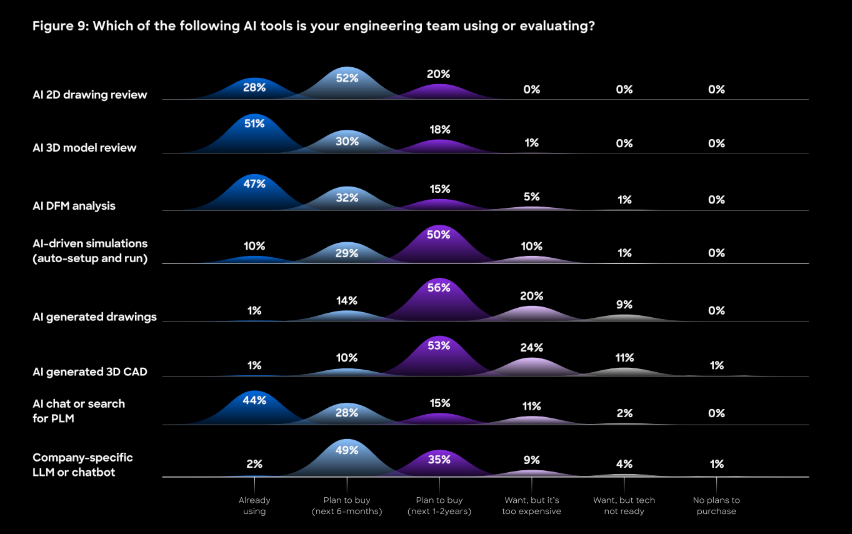
In a survey of 250 engineering leaders, 51% report already using AI-based 3D model review tools. These are typically rules-based systems that check CAD models against manufacturability constraints. They’ve been around for years and are widely accepted. A new class of agentic CAD review tools, like CoLab’s AutoReview, are also emerging. Because these tools use AI agents that can reason about designs, they remove the burden of manually updating rules libraries to ensure AI design review accuracy.
Interestingly, AI review for 2D drawings — historically underserved by rules engines — is seeing rapid momentum. Only 28% have adopted AI drawing review today, but 52% plan to purchase it within the next six months and another 20% within one to two years.
This suggests the next wave of AI in engineering may not be chatbots, it may be agentic review systems.
What are the best use cases for LLMs in PLM?
It’s important to separate “AI” from “LLMs.” Large language models are optimized for text. That’s why PLM vendors are using them for document vault search, summarization, and metadata queries. In those contexts, they perform well.
They are not, by themselves, optimized for:
- Interpreting CAD geometry
- Understanding GD&T symbols
- Running physics simulations
LLMs don’t understand many types of engineering data on their own. To get LLMs to understand engineering data requires data pre-processing and system level prompts. This is where agentic AI for engineering becomes important. An AI agent can combine LLM reasoning with other capabilities, like computer vision or custom machine learning models, and then return structured outputs in a repeatable way.
AI Search vs. PLM Copilots vs. Agentic Workflows
There’s also confusion around terminology. AI-powered PLM search is essentially conversational retrieval. It mirrors what ChatGPT does with the internet, but instead queries a company’s PLM data.
A PLM copilot is a broader concept. Today, most copilots are search-centric. In the future, they may initiate change workflows, update records, or circulate approvals. But that level of action-taking is still emerging.
Agentic AI workflows is a broader category. You can have agentic AI workflows inside PLM or outside of PLM. AI agents don’t just reason and return text answers, they can also use tools, and call APIs. That means they can execute multiple tasks in a row: setting up a simulation, running it, and returning the data or analyzing a drawing and creating markups. AI agents don’t have to live inside PLM to be effective, but many engineering AI agents benefit from access to PLM data.
The bigger shift: engineering AI beyond PLM
The most strategic takeaway for engineering leaders is this:
AI for PLM does not need to be confined to AI features embedded inside PLM software.
PLM will remain an important system of record. It houses CAD, BOM structures, change history, and product documentation. AI benefits from that data foundation.
But some of the most powerful AI applications may exist outside PLM, combining PLM data with:
- Design review conversations
- Lessons learned
- Requirements data
- Simulation outputs
- Testing feedback
As AI agents gain the ability to use tools directly — generating CAD iterations, running simulations, preparing change documentation — the human interface to engineering systems may shift. Engineers may spend less time navigating complex software menus and more time evaluating AI-generated options and collaborating on decisions.
In that world, PLM remains critical. But it becomes part of a broader shift: from human-powered engineering to humans working alongside AI agents to complete design cycles at previously impossible speeds. AI in product lifecycle management, for the most strategic engineering leaders, should mean adopting AI across the entire lifecycle — not just adding chat to a database. To learn more about our approach to agentic AI in new product development and sustaining engineering as a whole, see how we partner with engineering teams on AI transformation initiatives.



About the author
A former product manager for industrial equipment, MJ now leads marketing at CoLab.

