.png)
The Average Manufacturer Runs 35,340 Design Reviews a Year. Nearly Half Miss Critical Standards
The Average Manufacturer Runs 35,340 Design Reviews a Year. Nearly Half Miss Critical Standards


Key Takeaways
Manufacturing companies believe full AI adoption is critical within the next 12–24 months, with company survival listed as a prominent driver, according to a CoLab survey of 250 engineering leaders. The survey data makes clear:
- AI adoption among engineers has shifted from experimental, individual use to a need for manufacturing organizations to transform their processes.
- Drawing and design reviews have emerged as the logical starting point for AI workflows: they are repetitive, high-volume, and standards-based, making them ideal for automation.
- Leaders believe adopting AI at scale will dramatically accelerate design cycles, reduce errors, and strengthen global competitiveness.
.svg)
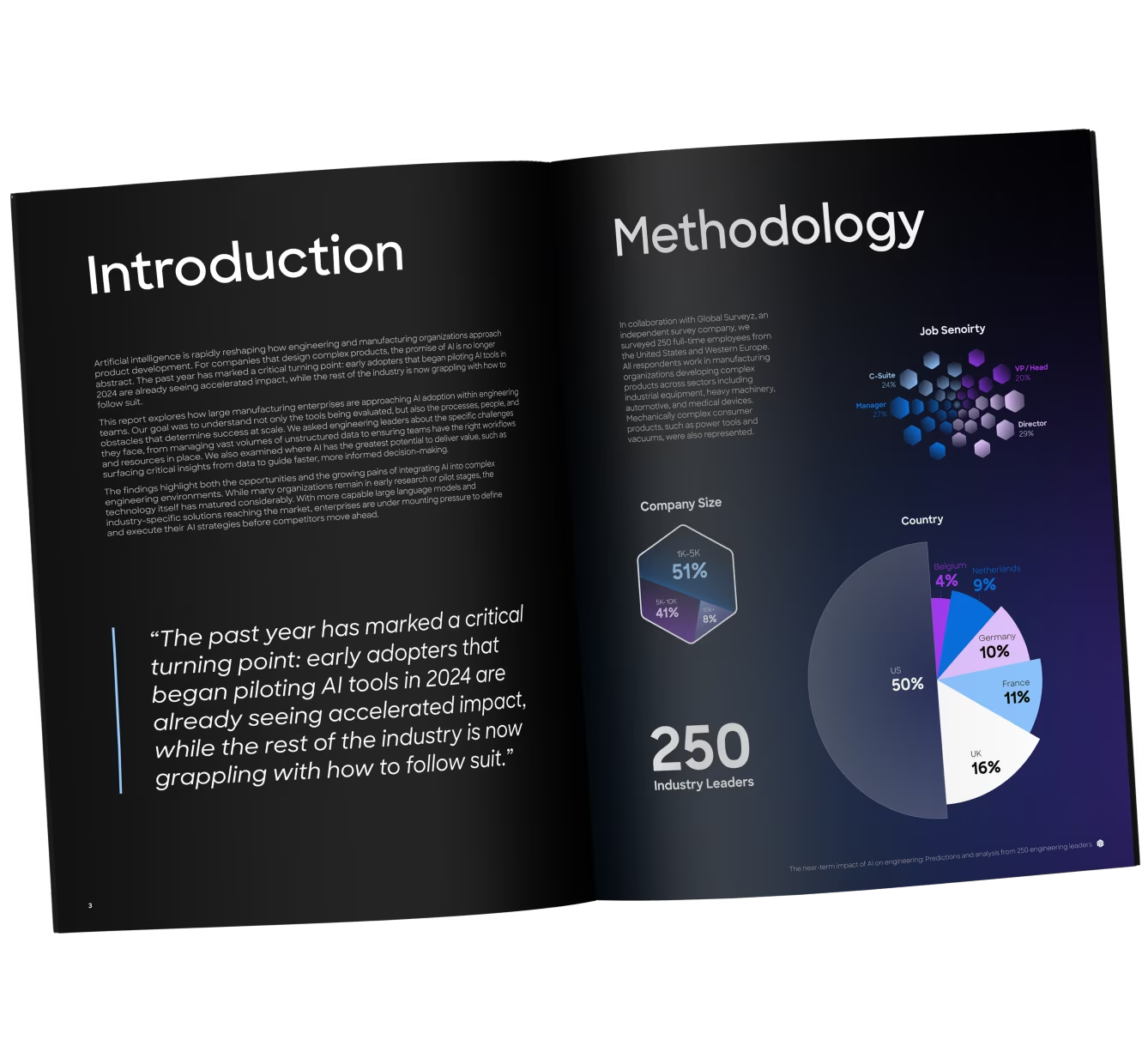
According to CoLab’s Near-Term Impact of AI on Engineering —a survey of 250 engineering leaders across large manufacturing organizations — the average company completes 35,340 drawing reviews every year.
That volume has made it increasingly difficult for companies to execute design reviews at the standards engineering leaders themselves expect.
Every engineer eventually faces a choice: do they run the process, or does the process run them? For many manufacturers, the data shows that design review is drifting toward the more troubling second state.
When engineering leaders talk about AI, they often jump straight to futuristic use cases. But CoLab’s data tells a different story, one where AI can make an immediate, measurable impact today if companies begin with design review.
Why design review is the right place to start: By the numbers
Design review is one of the most manual and repetitive processes in engineering. It’s governed by clearly defined standards and guidelines, requires attention to detail and often consumes an enormous amount of expert time that could be better spent elsewhere.
These characteristics make it one of the clearest near-term opportunities for AI in manufacturing.
The survey data reinforces just how widespread this workload is:
- 35% of organizations complete between 30,000–40,000 drawing reviews annually
- 16% conduct more than 50,000 reviews each year
- The average lands at 35,340 reviews per year
At this scale, even modest efficiency gains will compound quickly.
The hidden risk: standards matter, but they’re not consistently used
The high volume of design reviews creates a problem. CoLab’s report reveals a critical disconnect between how engineering leaders want standards applied and what happens in practice.
- 96% of engineering leaders say adherence to design standards is important or critically important
- 61% go further, saying failure to follow standards introduces safety, regulatory, or customer risk
- Yet only 56% of standards are documented, up to date, and consistently referenced during reviews
Let’s examine that gap.
If the average organization performs 35,340 drawing reviews per year, and standards are consistently applied in only 56% of them, that means:
Roughly 15,549 drawing reviews each year are not fully governed by standards and guidelines at the average manufacturer.
That’s built-in inefficiency soaking up hours of expertise.
When nearly half of a manufacturer’s reviews fail to apply basic standards—even when those standards are considered critically important—the system is no longer executing as intended. It’s due for an update.
Why AI drawing review is the right place to start
The design review process is exactly where AI delivers near-term ROI. Engineers already believe this. According to the report, engineering leaders estimate that 72% of drawing review work could be automated if AI systems are trained on company-specific standards and guidelines.
The goal here is that AI handles the standards-driven checks with consistency. That would free up engineers to focus on the complex, ambiguous, and judgment-heavy decisions that only senior experts can do.
The takeaway: start where the math makes the most sense
AI adoption can happen without it being a seismic shakeup to your company.
The data is clear:
· Drawing review is already one of the most resource-intensive processes in engineering.
· It’s governed by rules that AI excels at enforcing consistently.
Combine:
- 35,340 reviews per year
- 15,549 reviews not consistently using standards
with
- 72% of review work suitable for automation
Then you have a clear opportunity for improvement.
Want to learn more? Get The Near-Term Impact of AI on Engineering today.


This article is part of the CoLab Research Reports series, where we publish findings from both engineering leader surveys and aggregated, anonymized CoLab data.
The Near-Term Impact of AI on Engineering