
Talk to a product expert
Wire harness weaknesses reveal root causes of late-stage design failures


In complex engineering programs, wire harnesses are rarely the first thing teams worry about. They tend to appear late in the process, after major architectural decisions are made, after components are placed and after timelines begin to harden.
Yet when delays, rework, or manufacturing constraints surface, wire harnesses are often where the problems appear.
They act like a canary in the coal mine that appears too late, revealing problems that were introduced upstream, but only surface once it’s costly to respond.
Andy Clarke, Senior Customer Success Manager at CoLab, spent nearly a decade working at companies including Schlumberger and aPriori, as a mechanical engineer and DFM & cost consultant, respectively. As he puts it, “Wire harness is like the forgotten child of engineering. It is incredibly critical, but people generally assume it’s as simple as running a wire from here to there.”
That combination — critical yet underestimated — makes wire harnesses a useful case study for a broader issue. Wire harness issues are ideally suited to reveal how breakdowns in communication, design intent and feedback exchange can create late-stage risk in highly interdependent systems.
Why wire harnesses are easy to underestimate
From the outside, wire harness design can sound deceptively simple, more like practical electrical work than engineering.
That mental model is common, even among experienced teams. Compared to mechanical structures or electronic components, wiring can feel straightforward and something that can be fit in once the “real” engineering is done.
In practice, that assumption rarely holds.
“The complexity of how you run a wire through a car during initial manufacture, during service and then through repair can have a significant impact,” Clarke explains. Routing decisions affect bend radii, service access and manufacturability. Small changes that result in re-routing and increasing length can alter electrical resistance, forcing changes in wire gauge. Even connector choices ripple into cost, supply availability, and assembly effort.
What looks like a detail on its own is often part of a much larger system.
Where breakdowns really occur
In many engineering programs, wire harness teams — or, just as common, external harness suppliers — are brought in after core architectural decisions are already complete.
“The mechanical and architectural teams can consider these `thrown over the wall’ elements. `Here, we’re done. Figure out how to link this wire to this wire,’” Clarke says.
A frequently cited example is the Airbus A380 program. While wiring issues became visible problems late in development, the underlying challenge was coordination: teams working in different systems couldn’t easily see or validate how their decisions affected one another over a multi-year program. The end result was a delay that added years to development.
That’s the most extreme case. In everyday work, harness experts often immediately see problems. A routing path that’s too tight. A connector choice that creates unnecessary cost. A small geometric change that would have made installation easier if only it had been identified earlier.
“They’ll often say, ‘If you’d just moved that back a bit, or made a small cutout here for the wire to get around, it would have been fine,’” Clarke notes.
But when that feedback arrives late, options are limited. Changes become expensive. And concessions tend to be made downstream instead of upstream.
The compounding cost of late decisions
Wire harnesses are particularly unforgiving of late-stage change.
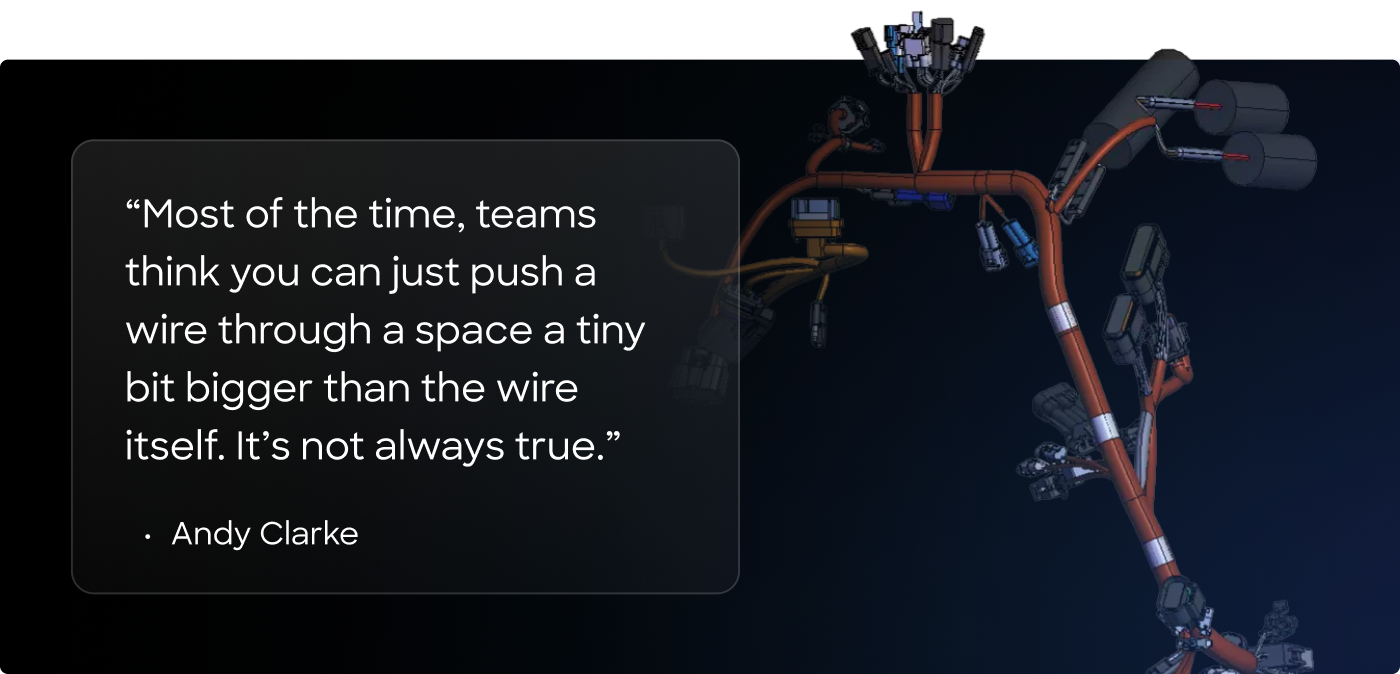
“Most of the time, teams think you can just push a wire through a space a tiny bit bigger than the wire itself,” Clarke explains. “It’s not always true.”
Routing constraints, bend limits, and assembly realities mean that designs that look viable in isolation can fail in context. And because harness manufacturing is highly manual — often involving custom jigs and precise cutting and bundling — even small changes can cascade.
“If you change the length required for a wire, you change the resistance,” Clarke says. “Which means you might need a thicker gauge wire.”
At that stage, the same decision that would have been inexpensive early becomes costly late.
Supplier expertise, without the right visibility
Wire harness design is also a specialist discipline, one that many companies rely on external suppliers to execute.
Suppliers often know which connectors are high-volume and low-cost, even if they appear more complex. They understand manufacturing constraints and service realities that aren’t always visible to upstream teams.
But that expertise only helps if suppliers are brought in early enough to influence decisions.
“If your design team knew what the high-runner, low-cost parts suppliers already had,” Clarke says, “even if it looks like a bigger or more capable connector, it might actually be cheaper because it’s a high-volume item.”
When suppliers are engaged late, their role shifts from collaborator to problem-solver under constraint. Instead of improving decisions, they’re forced to work around them.
Making intent and feedback visible earlier
What wire harnesses ultimately expose is a familiar pattern: late-stage failures rarely come from a single bad decision. They emerge when intent is assumed instead of shared, when feedback is delayed or disconnected, and when decisions are made without full context.
Good decision making requires making what already exists — intent, questions, constraints and trade-offs — visible earlier and in one place.
“That’s really CoLab 101,” says Clarke, who works directly with large-scale manufacturers in his role.
In practice, that means giving internal teams and external partners a shared space to review designs in context, regardless of whether they’re using CAD or 2D applications.
By reviewing designs in a shared environment, those specialists can point out issues while there’s still room to adjust geometry, routing paths or component choices. Feedback stays tied directly to the design itself, rather than living in email threads or static markups that lose context over time.
The result is clearer decision-making overall. Teams can see why something was done a certain way, who weighed in and what trade-offs were considered, long before problems surface downstream.
Why this pattern extends beyond wire harnesses
Wire harnesses are one of the most visible examples of this dynamic because they touch so many parts of a product at once. They intersect with mechanical layout, electrical performance, manufacturing processes, service access and supplier expertise.
But the pattern they reveal isn’t unique. Similar breakdowns appear anywhere engineering work is:
- Highly interdependent
- Spread across teams or organizations
- Sensitive to late-stage change
Thermal systems, packaging constraints, tolerance stack-ups, manufacturability reviews, compliance requirements all share the same risk profile. When specialists are brought in late, or when design intent isn’t clearly shared, issues don’t disappear. They resurface later, when options are fewer and costs are higher.
Wire harness issues don’t typically cause late-stage failures. They reveal where engineering processes are under strain.
By starting with a concrete, familiar case like wire harnesses, teams can see these issues most clearly. From there, ideally learning generalizes naturally: improving how intent, feedback and decisions move through the organization so that fewer problems make it to the end of the process.



About the author
Jon Filson is an industry analyst and writer for CoLab. Email him at jonfilson@colabsoftware.com.

