

Talk to a product expert
Lessons from China: How America can re-industralize and build again


A new book posits “the reality is that the United States will never again be a bigger manufacturer than China.” But in explaining that new reality, it also reveals clear lessons that can be learned by the U.S. should it want to take concrete steps towards re-industrialization.
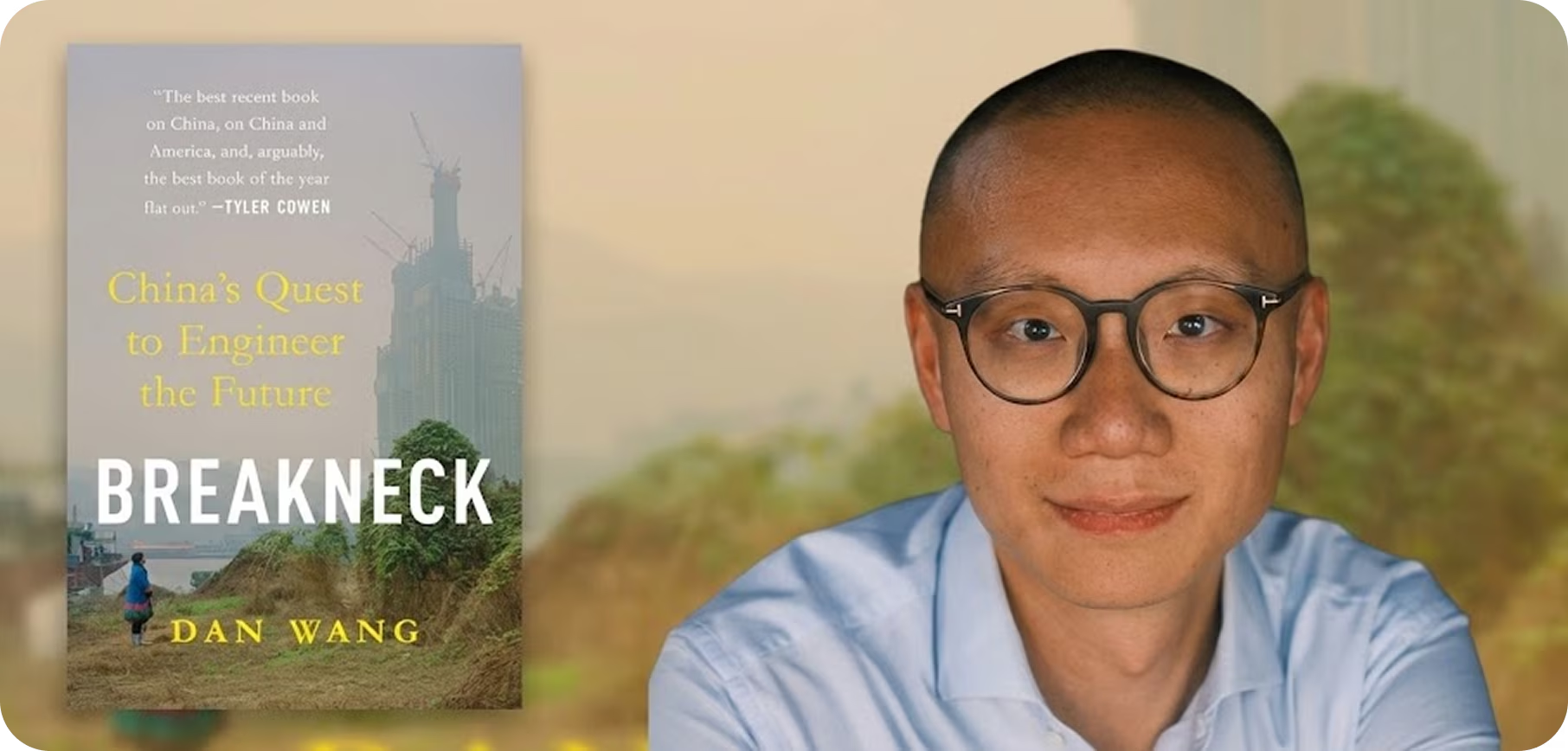
The gap between China and the United States when it comes to building can no longer be doubted, author Dan Wang reveals in Breakneck: China’s Quest to Engineer the Future.
The rate at which China can build today is astonishing. For example, “from 2003 to 2013, Shanghai added as much subway track as in the entire system in New York City. In 2025, fifty-one Chinese cities have subway lines, eleven of which are longer than New York’s. China now has a longer high-speed rail network than the rest of the world put together.”
And that’s just one of the proof points cited in Breakneck: China’s Quest to Engineer the Future, a new book that has hit multiple top 10 lists, such as this one and this one:
- “China’s fourth-poorest province – where household income is one-fifth of New York State – has vastly superior infrastructure: three times the length of New York’s highways as well as a functional high-speed rail network.”
- “China now has the capacity to produce around sixty million cars a year (one third electric, two thirds combustion), out of an annual global market of around ninety million cars sold.”
- “China is building most of the world’s renewable energy. In 2023, while the United States added 6 gigawatts of new wind installations, China added 76.”
Clearly China has taken a massive lead in both product manufacturing and major builds. But of course it wasn’t always this way. China’s current engineering prowess owes a clear debt to the United States: “If you want to appreciate what Detroit felt like at its peak, it’s probably better to experience that in Shenzhen than anywhere in the United States,” writes Dan Wang.
So China has learned from the United States. Can the reverse happen? Let’s have a look at the book’s lessons for the United States, as it seeks to re-industralize.
Elect more engineers as leaders
Instead of accelerating engineering processes, what the U.S. does is place a huge emphasis on legal processes, which have the effect of hampering engineering. China does the opposite, largely because it has engineers in charge of government.
According to Wang, if you look at who each country elects (or in China’s case, chooses, as it does not have free elections) as its leaders, you’ll see the priorities of the country. Current Chinese President Xi Jinping is a chemical engineer, who “filled the Politburo with executives from the country’s aerospace and weapons industries. In the United States, it would be as if the CEO of Boeing became the governor of Alaska, the chief executive of Lockheed Martin became the secretary of energy, and the head of NASA was governor of a state as large as Georgia.”
As for the U.S.? Only two presidents have ever been engineers. Lawyers dominate the political scene: regardless of which party controls the majority in Congress, at least half of the seats are typically occupied by someone with a law degree.
The impact of these leaders shows up in the priorities of the country. In the United States, “the lawyerly society is great at protecting the wealthy” while China’s engineering state “has a limited tolerance for how long infrastructure can be held up.”
The two approaches to government have massive impacts for anyone working as an engineer. CoLab’s Customer Success Manager Mike Farrell explains why:
“What drew me to this book is how clearly it captures the forces shaping the world that engineers work in every day. It offers a framework for understanding the two systems, American and Chinese, that sit behind the products, supply chains, and technologies we all depend on. What is striking is not just how different the two countries are, but how similar their ambitions and structural challenges have become.
“For anyone who builds things for a living, this context really matters. Engineers do not operate in isolation. They operate inside these larger systems. Whether we are talking about manufacturing capacity, regulatory friction, or global competition, the environment around engineering teams shapes their ability to execute. The book makes that incredibly clear.”
Celebrate superior processes as much as original ideas
“Americans expect innovations from scientists working at NASA, in universities, or in research labs. They celebrate the moment of invention: the first solar cell, the first personal computer, first in flight. In China, on the other hand, tech innovation emerges from the factory floor, when a new product is scaled up into mass production. At the heart of China’s ascendency in advanced technology is its spectacular capacity for learning by doing and consistently improving things.”
- Dan Wang, Breakneck
The book suggests that China focuses on improved manufacturing processes as its primary form of innovation as opposed to original inventions and ideas for new products.
The U.S. inverts this, heralding inventors with new ideas as geniuses, but then in comparison lets their advancements post-invention languish, Wang argues. The invention of artificial intelligence in America is a recent example of this playing out: Everyone agrees it’s a wonderful idea but its development has become uncertain along with its applications. Those elements have been left for companies to figure out for themselves.
CoLab’s Customer Success Manager Mike Farrell sees this every day working with clients in North America. These are common complaints from engineering leaders in North America that he sees:
• too much process kills momentum
• too much deference to risk slows innovation
• too little empowerment leaves engineers frustrated
“This matters because engineers want to build,” Mike says. “Yet many feel stuck in systems that reward caution instead of creation.”
Accept that around the globe stakeholder collaboration will only increase
If you’re intent on building quality products, learning to collaborate internationally is increasingly crucial. “The idea of having something designed in California and manufactured elsewhere “requires a kind of hand in-glove partnership,” according to Apple CEO Tim Cook, who is quoted in the book.
With China assuming 45 per cent of the world’s industrial capacity by 2030, according to the book, being able to collaborate regularly and easily with suppliers is only going to become a larger issue for North American companies to grapple with.
“The sooner that the United States treats China as a peer worth studying, the sooner it can develop a new playbook for success.”
Wang goes further, suggesting the United States use its clout to force collaboration with China if it has to. “Chinese companies are currently beating the rest of the world in the production of electric vehicle batteries. So why not allow a few of them to build factories, as they are trying to do, in states like Michigan, to force them to give up their technology? The U.S. government could force Chinese battery makers to transfer intellectual property in exchange for accessing the giant U.S. market for cars.”
Build what people need
There’s an over-riding message for American engineers, which Wang explained in an interview:
“I hope that the U.S. could be, let's say, 20% more engineering, such that if the very rich state of California declares we are going to have high-speed rail, then we're going to get high-speed rail. And it should really gleam once people are sitting in these trains. And I think that the U.S. needs to just build a lot more of the things that people need.
Not just the homes, but also the vast manufacturing base, which I think has been rusting throughout the U.S. as the U.S. hasn't built enough planes, enough semiconductors to meet people's needs.”
Dan Wang, “Lessons for the U.S. in 'China’s quest to engineer the future”
A core argument in the book is that Wang sees China as actually building products that actually create a better life for its citizens in many ways, with high-speed rail and other climate-change friendly advances cited as primary examples. The United States has been a laggard here, not because it lacks ability, but the will.
CoLab analysis: How this connects to my work at CoLab
Engineers are not typically motivated by abstract strategy, CoLab’s Mike Farrell says. “They want to solve real problems and build real things.”
“If America wants to strengthen its ability to build, empowering engineers is one of the highest leverage opportunities available,” he says. “If we learn from both systems, China’s commitment to execution and America’s tradition of ingenuity and openness, we can rebuild a culture that values getting things done.”



About the author
Jon Filson is an industry analyst and writer for CoLab. Email him at jonfilson@colabsoftware.com.

