

Talk to a product expert
Best AI Tools for DFM: A Guide for Mechanical Engineers


This harsh reality is clear for engineers today: Traditional manufacturability workflows are struggling to keep up with design volume, part complexity and compressed development timelines. DFM reviews remain largely manual, relying on senior engineers to catch geometric issues, standards violations, and process-specific risks across machining, sheet metal, molding, and casting. As teams scale, this approach breaks down: reviews become inconsistent, the same DFM issues repeat across programs, and critical feedback arrives too late.
So, engineering teams are looking to AI tools to help with DFM reviews. Hundreds of front-line engineers and engineering leaders believe AI is the answer not because it replaces engineers but because it augments them. They believe AI tools can act as a first-pass reviewer, a memory system for past lessons, and a way to scale expert judgment across teams and time.
However there’s still a massive gap. Not the gap with whether or not to adopt AI DFM tools, but which tools to adopt, and why.
This guide is designed to help engineering teams make that decision deliberately and with access to the AI DFM tool knowledge available today.
A quick primer first: rules-based DFM vs. true AI DFM
Not all “AI DFM” tools are the same, and many tools marketed as AI are more like automations when you peel back the layers. Let’s explore the differences and when it’s right to use one, the other or both.
Rules-based DFM automation
Rules-based tools operate from explicit, human-authored guidelines. Engineers or administrators define what constitutes acceptable geometry or standards compliance, like minimum draft angles, bend distances, hole depth ratios, modeling conventions, and the software checks designs against those rules.
These tools are predictable, auditable, and excellent at enforcing known best practices. They are especially valuable in regulated industries or large organizations where consistency matters.
What’s often overlooked is the time and effort required to reach that level of consistency. Rules must be written, validated, and continuously maintained as designs, suppliers, materials, and manufacturing processes change.
Moreover, they only know what has been codified; anything not written into a rule effectively doesn’t exist.
True AI / ML-driven DFM
AI-driven DFM tools learn from historical data rather than relying solely on predefined rules. They analyze patterns from past design reviews, supplier feedback, quotes, ECOs, and manufacturing outcomes to identify designs that resemble ones that caused problems before.
These tools are strongest at scaling experience, catching repeat issues, and preserving institutional knowledge. This is particularly valuable for surfacing issues that show up repeatedly in reviews but are rarely formalized as rules.
They tend to improve over time as more data flows through them, but they can be harder to explain feature-by-feature and depend heavily on adoption and data quality.
AI DFM tool recommendations by software category
AI-Assisted DFM Review & Knowledge Management Platforms
Example tools:
How this category works
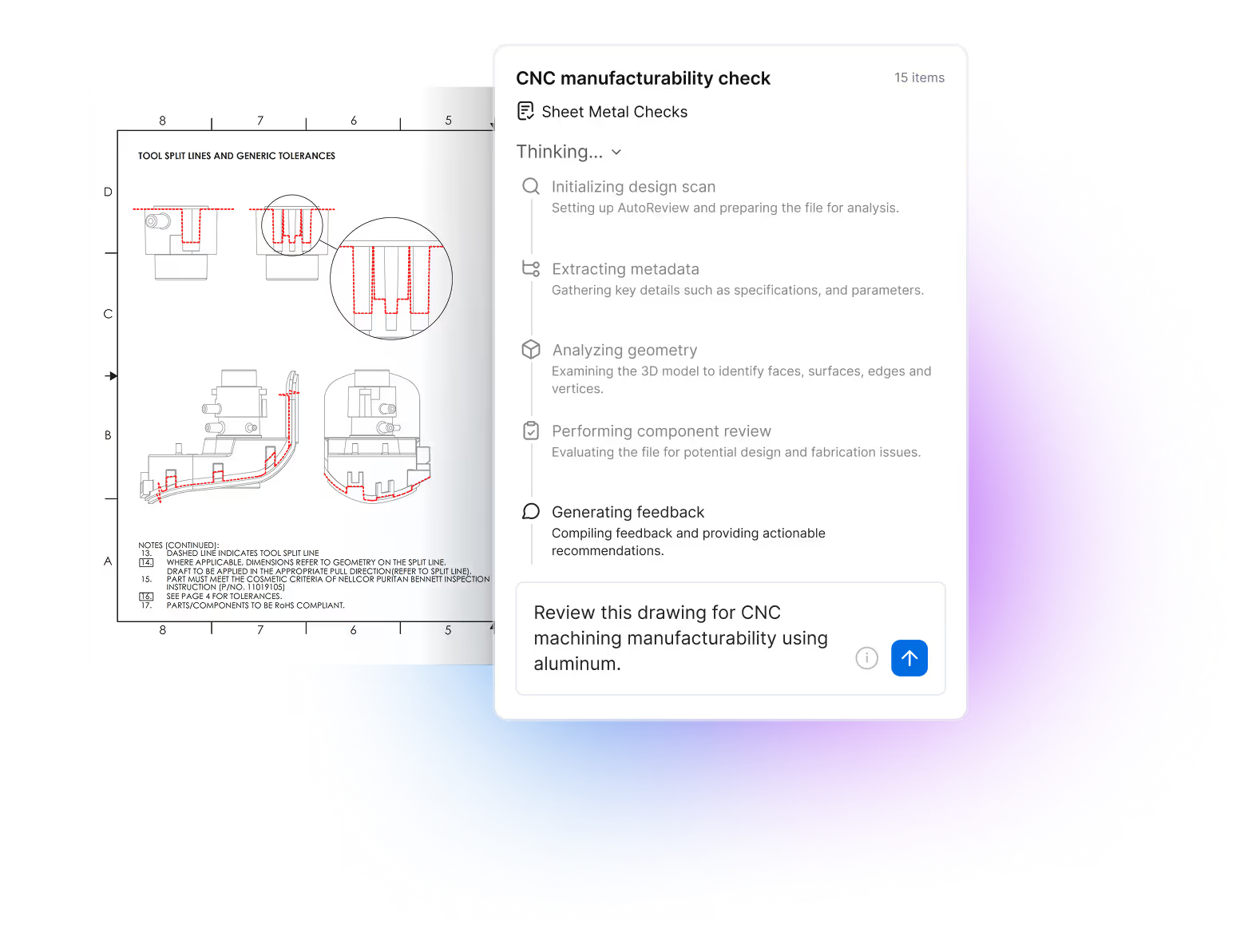
These platforms sit in the design review workflow rather than deep inside CAD. They use true AI and machine learning to analyze models and drawings, flag common DFM issues, and learn from past human feedback and decisions.
Over time, they identify patterns like “features that always get flagged,” “issues that trigger late ECOs,” or “manufacturing concerns that slip past rule checks.”
This allows teams to surface risks that were never formally documented as rules but repeatedly caused downstream rework or delays.
Strengths
- Scales real engineering judgment across teams
- Captures and reuses tribal DFM knowledge
- Reduces late-stage DFM surprises and ECO churn
- Works across multiple manufacturing processes
Weaknesses
- Not a physics simulator or cost engine
- Value depends on consistent review adoption
Best use cases
- Cross-functional design reviews
- Organizations with recurring DFM processes or issues
- Teams growing faster than their expert headcount or with regular turnover
- Preventing “we’ve seen this before” mistakes
Industries / companies that benefit most
- Mid-to-large manufacturing companies in aerospace and defense, medical device, industrial machinery, consumer goods, semiconductor manufacturing, and robotics
- Distributed or remote engineering teams
- Teams with extensive supplier networks
This category excels where experience and nuance matters more than explicit rules. It is particularly effective in environments where issues are known anecdotally but difficult to fully codify upfront.
.avif)
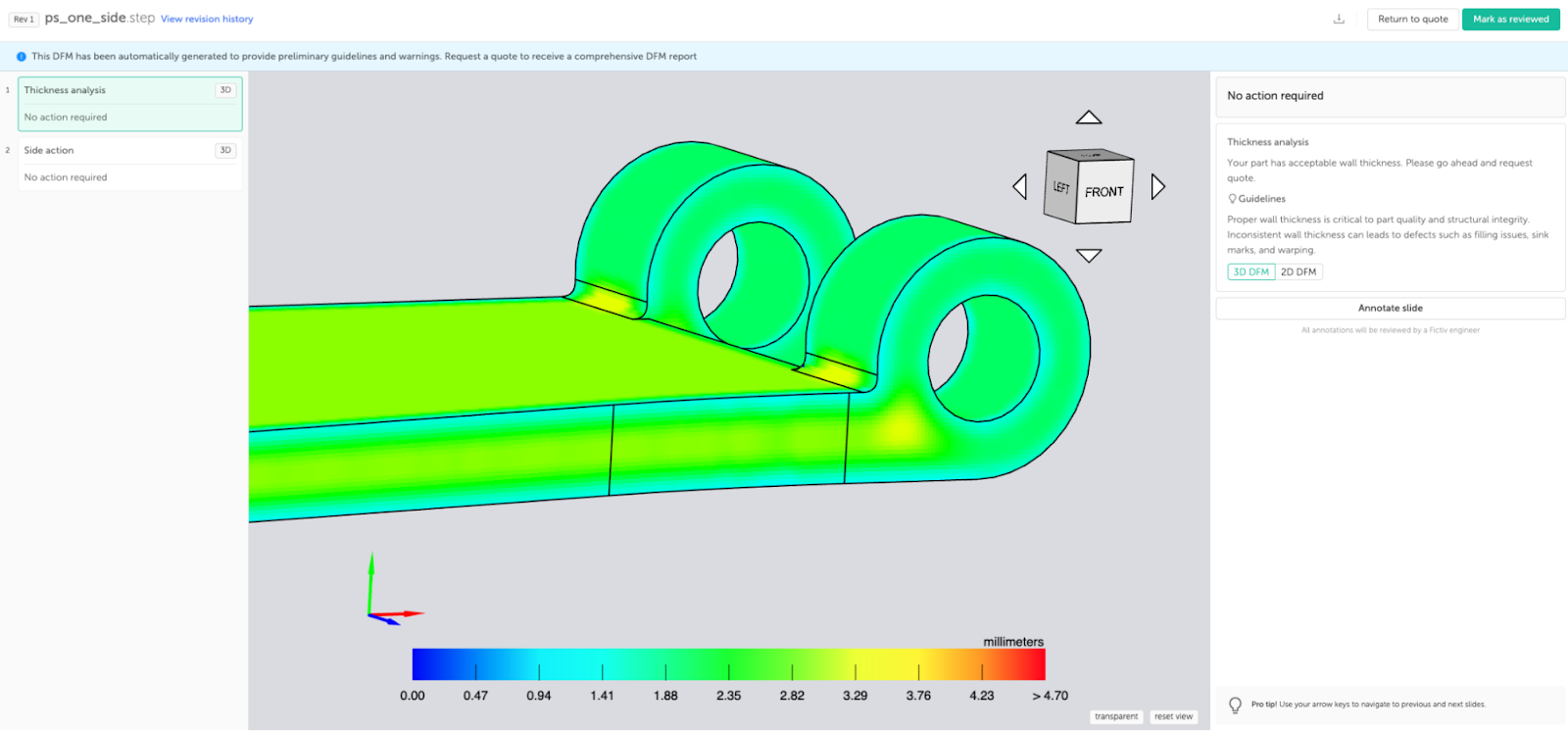
Rules-Based, CAD-Integrated DFM Checkers
Example tools:
How this category works
These tools run directly inside or alongside CAD systems and evaluate geometry against predefined manufacturability or standards rules. They provide immediate feedback while a designer is modeling, but their effectiveness depends heavily on the breadth, accuracy, and ongoing maintenance of rules.
Strengths
- Predictable and explainable
- Excellent for preventing basic, repeatable mistakes
- Strong fit for onboarding and standards enforcement
- Works very early in the design process
Weaknesses
- Requires significant upfront configuration and extensive ongoing rule maintenance
- Limited to what has been explicitly encoded
- Poor at judging cost, complexity, or subtle tradeoffs
Best use cases
- Machining, sheet metal, and basic injection molding hygiene
- Enforcing company CAD and drawing standards
- Regulated or audit-heavy environments
Industries / companies that benefit most
- Aerospace & defense, Medical device, Automotive Tier 1s and Industrial equipment manufacturers
These tools should be viewed as a baseline layer, not a complete DFM solution.
Increasingly, teams are using AI-assisted review platforms to take on a larger share of this role, reducing dependence on exhaustive rule coverage and catching geometry-related issues that rules alone miss.
Quote-Driven, Manufacturing Network DFM Engines
Example tools:
How this category works
These tools analyze geometry in the context of real manufacturing networks. They use a combination of automation and machine learning trained on historical quotes and outcomes to provide instant feedback on manufacturability, cost drivers, and lead times.
In practice, the analysis is tightly coupled to quoting workflows and supplier capabilities, rather than a deep understanding of design intent, feature relationships, or broader DFM patterns across a product’s lifecycle.
Feedback is often derived from how similar parts have been quoted or produced before, not from interpreting the full geometry and context the way an engineer would when reviewing a design for manufacturability.
Strengths
- Very fast feedback tied to real manufacturing capacity
- Strong intuition for cost and complexity
- Excellent for outsourced manufacturing
Weaknesses
- Feedback reflects the platform’s supplier network
- Less useful for proprietary or in-house processes
- Not ideal for early conceptual design
- Limited visibility into how design issues recur or evolve across reviews
- Not built to capture or reuse geometry-level engineering feedback
Best use cases
- Prototype and low-to-mid volume production
- Rapid iteration cycles
- Early cost and sourcing sanity checks
Industries / companies that benefit most
- Hardware startups
- R&D and innovation teams
- Consumer products
- Robotics and electronics enclosures
These tools are best treated as reality checks, not final authorities.
Costing & Manufacturing Simulation Platforms
Example tools:
How this category works
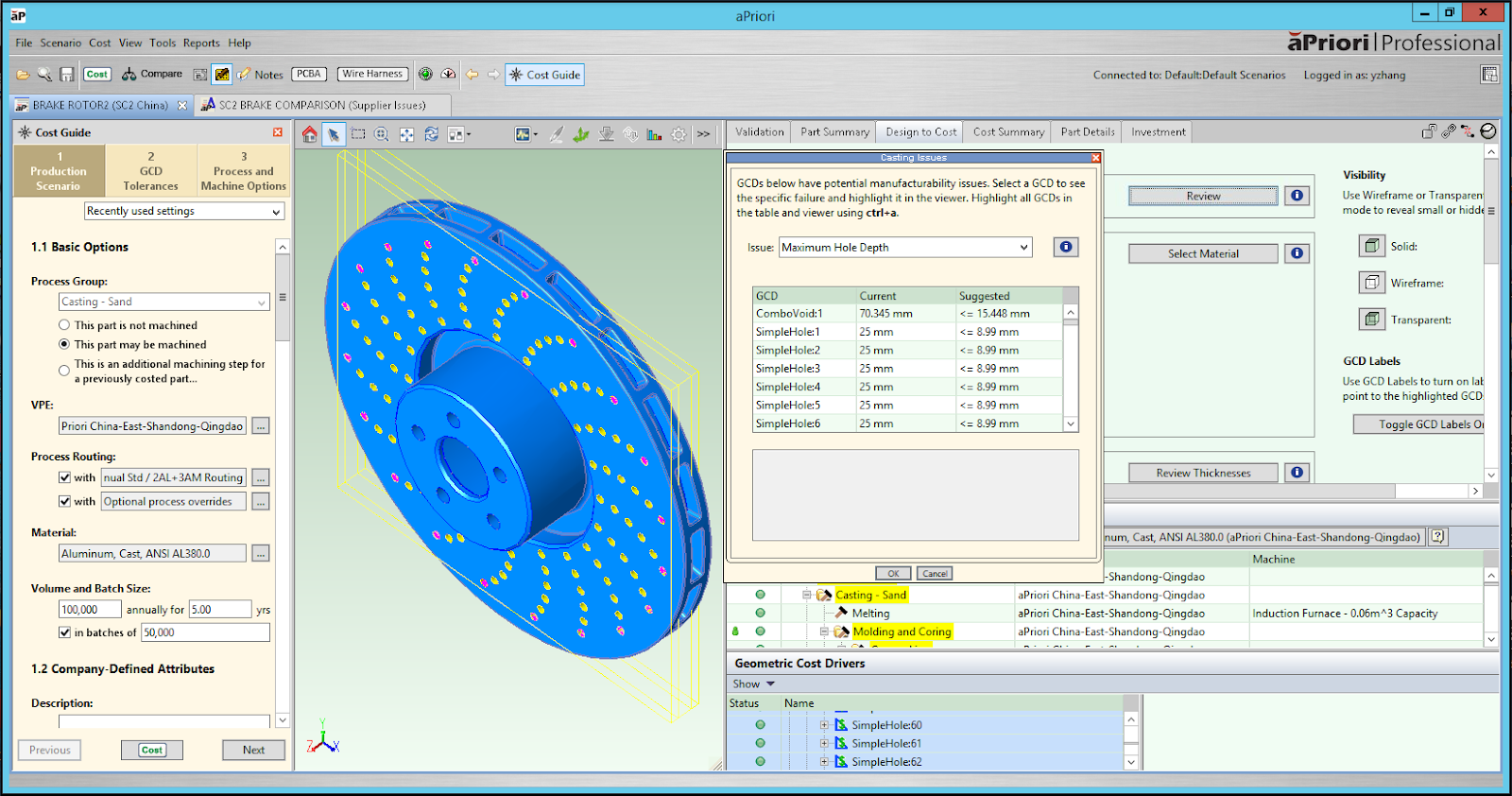
These platforms model manufacturing processes, materials, tooling, and regional factors to estimate cost and manufacturability. They help teams compare processes and understand design-to-cost tradeoffs early.
Strengths
- Excellent for strategic decision-making
- Strong insight into cost drivers
- Supports make/buy and process selection
Weaknesses
- Significant setup and configuration effort
- Not used daily by most designers
- Doesn’t replace detailed DFM checks
Best use cases
- Design-to-cost programs
- Manufacturing strategy and sourcing
- High-volume or high-spend components
Industries / companies that benefit most
- Automotive
- Heavy equipment
- Appliances & HVAC
- Energy and infrastructure
These tools guide what to build, not how to model it day to day. Furthermore, these are based on a mix of rules-based checkers and automations and do not have full AI solutions quite yet.
AI DFM tool recommendation matrix: Based on use case
AI DFM tool recommendations by manufacturing process
Sometimes the use case for an AI DFM tool is not necessarily workflow-driven, but more process-driven. And different manufacturing processes fail in different ways. The most effective AI DFM tool strategy starts by understanding how a process breaks, then selecting tools that are good at catching those specific failure modes.
What follows is a process-by-process AI DFM tool recommendation for the more common manufacturing processes: machining, sheet metal, injection molding, and casting.
Machining (CNC milling & turning)
Where machining DFM typically fails
Machining DFM issues are rarely about whether a part is theoretically manufacturable. They’re about tool access, unnecessary precision, and hidden cost drivers. Deep pockets, sharp internal corners, long-reach tools, and over-tolerancing are the most common sources of friction between those designing the product and those actually manufacturing it.
Recommended DFM tool approach
Here’s how each AI DFM tool category solves for the pains specific to machining:
- Rules-based CAD DFM tools should be the first line of defense for the design engineer. They reliably catch basic violations such as unrealistic corner radii, hole depth-to-diameter issues, and non-standard feature geometry.
- AI-assisted review platforms (like CoLab) add the next layer of DFM sophistication by surfacing machining issues that repeatedly show up in reviews or from previous shop feedback — especially those that technically pass rules but cause pain in practice. This includes geometry that is manufacturable in theory but repeatedly drives cost, setup complexity, or supplier pushback across programs.
- Quote-driven DFM engines are valuable when machining is outsourced. They provide fast insight into which features drive cost or lead time, even when the geometry is nominally valid.
Sheet metal fabrication
How sheet metal typically fails
Sheet metal designs often fail due to bend sequencing, tooling clearance, and flat-pattern constraints, and not because the final shape looks wrong in CAD. Holes too close to bends, unrealistic bend radii, or unbendable sequences are common problems that CAD designers often miss but tooling managers or manufacturers spot right away.
Recommended DFM tool approach
Sheet metal is one of the strongest cases for rules-based automation, complemented by review intelligence:
- Rules-based CAD DFM tools are extremely effective at enforcing minimum bend radii, bend-to-hole distances, and relief requirements.
- AI-assisted review platforms (like CoLab) help catch repeat sheet metal issues that aren’t purely geometric, such as manufacturing preferences, tolerance stackups, or vendor-specific feedback.
- Quote-driven tools are useful for rapid validation against real press brake capabilities, especially in prototype or low-volume production.
Injection molding
How injection molding typically fails
Injection molding failures are driven by flow, cooling, and release, not just shape. Insufficient draft, inconsistent wall thickness, thick-to-thin transitions, and poorly designed ribs or bosses are common root cause failures. Injection molding has a high potential benefit from AI tools and rules-based automation because mistakes are expensive once tooling is already cut.
Recommended DFM tool approach
Injection molding benefits from early rule enforcement plus experience-driven review:
- Rules-based DFM tools are essential early. They reliably enforce draft, wall thickness, rib proportions, and basic moldability guidelines while designs are still fluid.
- AI-assisted review platforms (like CoLab) play a critical role by capturing real-world molding feedback from manufacturing and suppliers. These tools help teams avoid repeating mistakes that don’t show up as strict rule violations. This positions AI-assisted review not just as a supplement, but as a way to consistently apply hard-won molding experience earlier in the design cycle.
- Additionally, CoLab comes equipped with basic manufacturing process checkers out-of-the-box, so you can catch basic errors early and then train AI on your company-specific standards and guidelines.
- Costing and simulation platforms are valuable when deciding whether a part should be molded at all, or when comparing tooling complexity and long-term unit cost.
Casting (die casting, sand casting, investment casting)
How casting typically fails
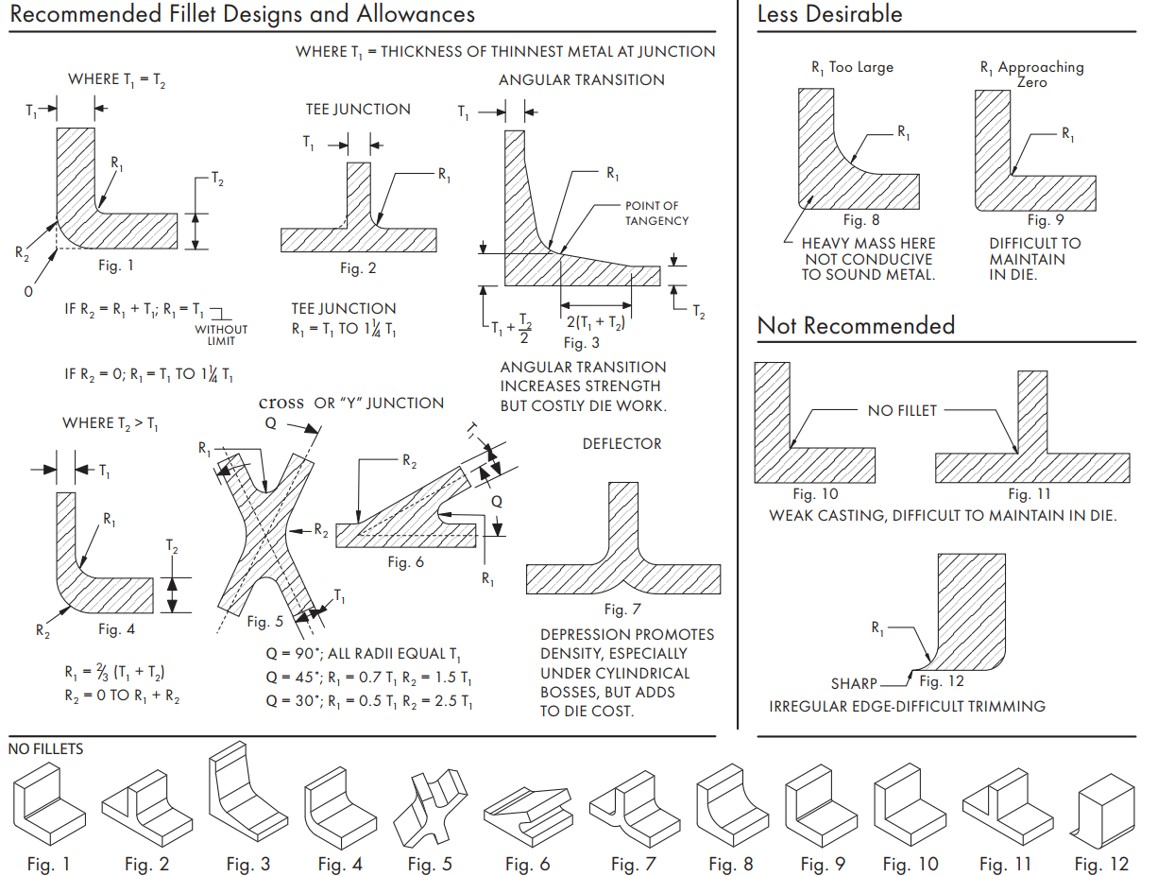
Casting failures are rarely obvious from geometry alone. Non-uniform wall thickness, isolated heavy sections, poor parting line decisions, and impractical core designs lead to shrinkage, porosity, or yield issues. Companies typically rely heavily on engineers or manufacturing personnel with foundry experience and deep institutional knowledge.
Recommended DFM tool approach
Casting is best supported by experience capture and cost insight, rather than rigid automation:
- Rules-based DFM tools help eliminate clearly un-castable geometry early, especially around draft, fillets, and wall uniformity.
- AI-assisted review platforms (like CoLab) are particularly valuable for casting because foundry feedback is often qualitative and experience-driven. Capturing and reusing that feedback prevents repeated mistakes across programs. In many casting workflows, this experience capture becomes the primary DFM safeguard as rules struggle to encode qualitative foundry knowledge.
- Cost and manufacturing simulation tools support high-level decisions around process selection, tooling investment, and regional sourcing.
Key takeaways by process
- Machining & sheet metal: Rules-based checks form a strong foundation, but AI-assisted review is what eliminates repeated expert feedback and mistakes.
- Injection molding: Rules catch early geometry issues; AI-driven review prevents expensive tooling surprises.
- Casting: Experience matters more than rules; AI-assisted knowledge capture delivers the most value.
Across all processes, the most effective strategy is not choosing one AI DFM tool, but assembling a process-specific DFM stack that reflects how parts are actually manufactured.
AI DFM tools don’t replace engineering judgement
As we emphasized earlier, AI DFM tools are not a substitute for engineering judgment. They are force multipliers. Very rarely do engineering teams come to us thinking AI will replace engineers. They are, instead, looking for ways to reduce the administrative burden of DFM workflows today.
Engineers want AI DFM tools that:
- Detect maufacturability issues earlier and more consistently
- Reduce the dependence on a few senior engineers
- Capture and reuse of institutional DFM knowledge
- Reduce time spent on low-value review work
- Eliminate late-stage surprises and costly rework
Rules-based tools are best when the problem is well understood. AI-driven tools are best when experience matters and feedback repeats. The most effective teams combine both and are intentional about where each tool fits in the workflow.
In 2026, the question isn’t whether to invest in AI DFM tools. It’s whether your organization wants to continuously relearn the same lessons, or capture and scale them once.
If you’re ready to explore what an AI DFM strategy might look like for your team, schedule a consultation call with a CoLab product expert here.



Frequently Asked Questions
How does AI CAD review differ from traditional rule-based DFM software?
Traditional Design for Manufacturability (DFM) and should-costing tools are highly programmatic point solutions. They rely on static, hard-coded geometric rulesets. While effective for basic point-in-time checks, they operate in a silo and often generate a high volume of "false positive" noise. Once an error is flagged, the engineer still has to take a screenshot, create a presentation, and email a supplier to discuss a fix.
Modern Agentic AI CAD review software solves this by combining automated checks with a cloud-based collaborative environment. Instead of just highlighting a problem, the AI drops a 3D pin directly on the CAD model, cites the specific internal company standard that was violated, and allows the designer to instantly tag a manufacturing engineer or external supplier to resolve the issue in real-time without leaving the platform.
About the author
Mary Keough is a real human and writer for CoLab. Email her at marykeough@colabsoftware.com.

