
Talk to a product expert
Want To Transform Your Engineering Organization With AI? Start With DFM.


Almost every engineering executive we’ve spoken with over the past 12 months has asked some version of the same question: what value is AI actually bringing to manufacturing and new product development?
AI transformation projects can fail for many reasons. Research from MIT found only 5% of custom AI pilots ever reach production. The most common failure mode we’ve seen comes down to misaligned scope: organizations don’t clearly define the problem, so they underestimate what it takes to solve it. They try to tackle everything at once. It’s especially hard for large manufacturers, where an AI pilot that works for one team has to become a new way of working for thousands of people.
That doesn’t mean AI can’t work in large organizations. And it isn’t a reason to wait on pilots. It is a reason to be careful about where you place your AI bet.
In our work with large manufacturers, one use case stands out as the ideal starting point: design for manufacturing (DFM). Several of the largest manufacturers we work with are already investing in it. One global manufacturer has made DFM one of its top five priorities. Another is investing seven figures in systemizing it with AI.
For large manufacturers, DFM is the right first AI bet for three reasons:
- The payoff is big, and the change management effort is small by comparison. At enterprise volume, a small design change can be worth millions, and the work fits into reviews teams already run.
- It fixes a problem that always gets worse in large organizations. With programs running across multiple plants and a global team, manual checks are difficult to enforce.
- The data to solve the problem already exists. Decades of programs have provided the standards, past designs, and expert judgment to make AI useful. That knowledge just isn’t reaching every design yet.
Here’s how each one plays out inside a large manufacturer, and how to turn DFM into an AI investment that shows up on your P&L.
Small DFM improvements deliver large ROI
Shave $1 off the bill of materials for a part you build a million times, and you’ve saved $1 million. Now, multiply that across thousands of SKUs and dozens of programs. The business case for robust DFM at scale quickly becomes clear. And the savings aren’t only in the bill of materials. A feature that’s harder to make than it needs to be can mean costlier tooling, longer lead times, an extra machining step, and scrap and rework on every part that comes off the line.
That’s what makes DFM different from the AI pilots that never reach the P&L. Leadership needs returns big enough to matter without asking thousands of engineers to change how they work all at once. DFM fits inside the design reviews and checks your teams already run. The change management is relatively straightforward, and the payoff scales with every part you make.
Here’s what that looks like in practice. One team at an automotive supplier we work with didn’t try to tackle all of DFM at once. They started with a single application: design guidelines for injection molded parts. For a company making millions of plastic parts each year, improving upstream design outcomes for just one production process represents a seven-figure business case. Our CTO, Jeremy Andrews, explains the full implementation in this article. Here’s what other large manufacturers can take from it:
- Start with the rules you already have. The team turned its existing written guidelines into automated checks that run on the 3D model.
- Get findings to designers early. Engineers run the checks while the design can still change. Each finding points to a specific feature and the guideline behind it, and engineers decide what to act on.
- Expand one slice at a time. Next up are plating and stamping in other business units. There, the rules live mostly in written documents and get missed. The design calls for the wrong plating thickness or finish, and the team either reworks it or lives with a less efficient process.
In the worst case, tier 1 automotive suppliers have told us they win business and then learn at production kickoff that the part can’t be made.
That’s where AI in DFM can pay off first: checking a design against your rules while it’s still in the 3D model. Catch a problem there, and the savings appear on every part you make.
Today’s DFM methods can’t keep up at enterprise scale
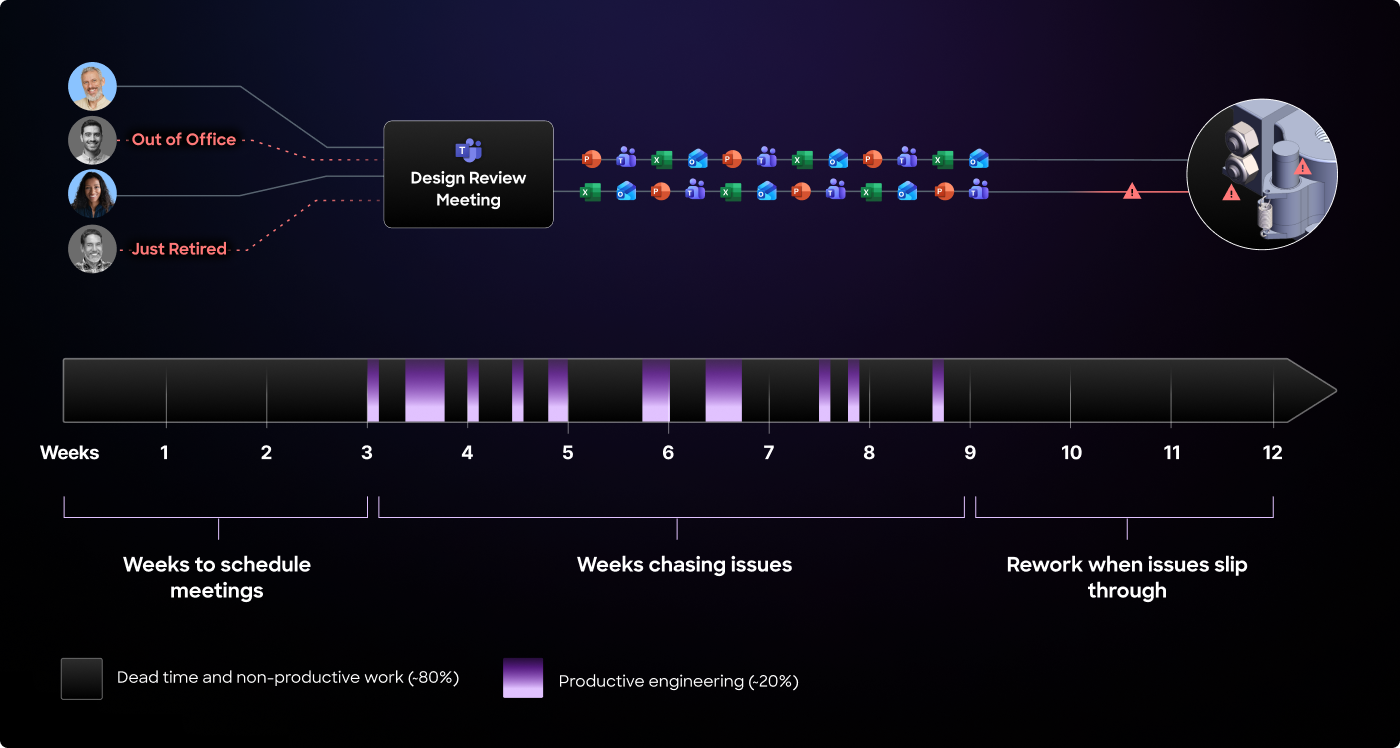
If a missed issue costs this much, why do the same problems keep reaching production? In our experience, it’s because the way most companies run DFM doesn’t scale to enterprise organizations. At a small company, manual DFM can work fine. A few engineers know the rules and standards, one experienced manufacturing engineer sees every design, and problems get caught over someone’s shoulder.
A large manufacturer has a different problem. New designs are coming in all the time across dozens of programs and sites. Each one needs to be checked against hundreds of rules. Every new design introduces more manual checks, but the number of experts who can do them stays the same.
The fixes that work at small companies don’t scale to large manufacturers:
- Checklists only help if every engineer finds the right rules and applies them consistently
- Programmable checks need constant upkeep
- Experts can’t sit in on every design review, so feedback shows up too late
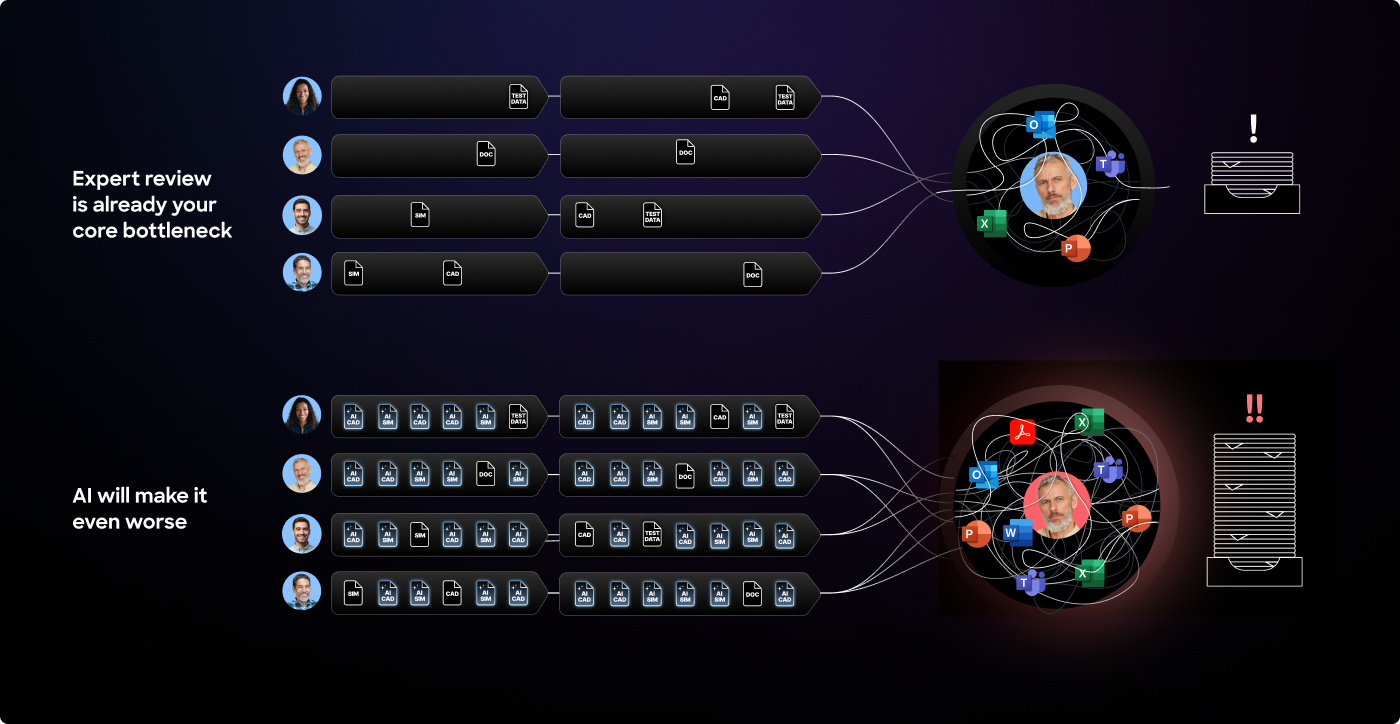
We keep hearing about huge companies where one person reviews every design for entire teams. That expert review bottleneck will only grow tighter as AI-generated designs proliferate. We’re already seeing it in software. AI agents are driving what GitHub calls “exponential growth” in code, and its CTO wrote that the company now has to design for 30X today’s scale to keep up.
Code review takes hours. Hardware review can take months. Every AI-generated design still needs review, so if review is already your bottleneck more designs will just make it worse.
The good news is that the same technology can help with the checking. AI can act as an effective checker if it’s given the right context. At large manufacturers, that starts with the collective knowledge that already exists inside your organization.
Large manufacturers already have the knowledge that AI needs to systematize DFM
Your most valuable AI opportunity might be the manufacturing mistakes your company already knows how to prevent.
At a large manufacturer, that knowledge is everywhere. It lives in your internal design standards and also the third-party standards that you’ve paid for, such as ISO and ASME. It’s in checklists, supplier feedback, and review notes from thousands of past designs. It’s in the heads of your most experienced engineers. That’s the raw material AI needs to give useful answers. The work is picking the right pieces, organizing them, and putting them to work.
It’s also your competitive advantage. AI models keep improving, and everyone has access to them. We think they’ll soon become a commodity. What your organization has learned over decades is yours alone—no competitor can buy it.
Large manufacturers have the most to gain here, and the most to lose. Experience is spread across sites and teams, so a lesson learned in one plant rarely reaches a designer in another. And a lot of it walks out the door when experienced people retire. That’s one of the biggest worries we hear from customers.
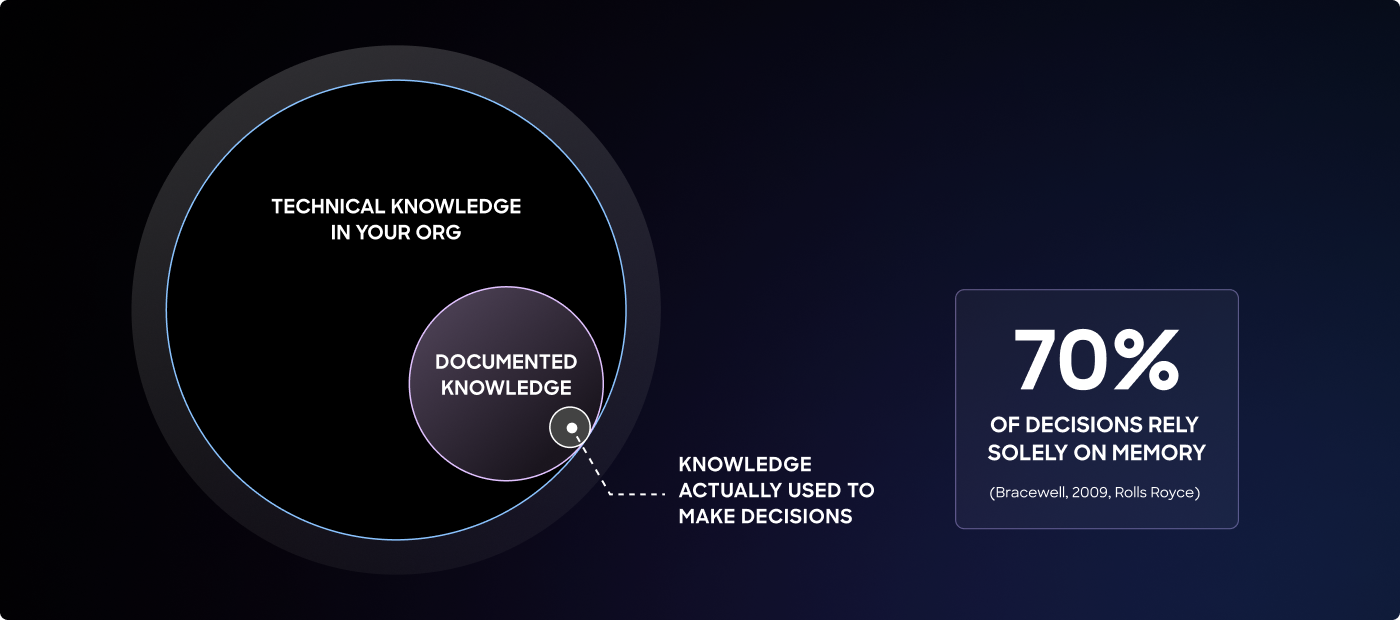
The question is whether that knowledge reaches the next design before the same mistake happens again. Several large manufacturers we work with are tackling this head-on, including:
- Vestas, one of the world’s leading wind turbine manufacturers, is exploring how AI can help apply its internal guidelines during design reviews and surface DFM feedback automatically, as part of its partnership with CoLab.
- Bombardier, the Canadian business jet manufacturer, will capture lessons learned automatically and resurface them when they matter on future programs, as part of a multi-year AI agreement with CoLab.
Putting that knowledge to work on every design, every time, is a natural job for AI. Do it well, and you protect what your company knows while saving engineers hours of digging through documents.
What it takes to scale DFM with AI at a global manufacturer
Scaling DFM with AI inside a large manufacturer requires a partnership, not just a purchase. A successful rollout puts what your organization knows about making parts in front of every designer, on every program, at every site. No product does that out of the box.
Much of the knowledge required to build that system isn’t written down—it’s inside the heads of SMEs or stuck in one plant. A generic tool won’t know your standards. You can build it yourself, but MIT found you’re about half as likely to reach deployment as companies that work with a partner.
So what you’re really buying is two things. One is a platform where designs get reviewed, expert knowledge gets captured, and AI agents flag issues on 3D models and drawings for engineers to act on. The other is a partnership to do the work specific to your organization: custom checks and agents for your designs and processes, and integrations with PLM and the other systems where your data lives.
At CoLab, that’s how we work with large manufacturers to drive AI transformation that hits the P&L. Here’s how Nadia Malik, Head of Strategy, Digital & Governance at Bombardier, puts it:
“We are doing R&D with CoLab. It’s not just ‘you take it off the shelf’ with us, they’ve been a fantastic partner to understand how we do business. And we believe that’s how we’re going to get a competitive edge when we talk about AI and how we’re going to deploy it within the company.”
The work starts with executive alignment. Then our forward-deployed mechanical and software engineers audit your standards, data, and systems, and build a 12-month plan of sprints with you. For one customer, a sprint delivered targeted agents to tackle three specific checks to gain consistency around pre-production drawing reviews. For another, it meant restructuring five sets of standards—including wire harness, sheet metal, and thermal—so agents could parse them and give targeted feedback. In both cases, most of the work wasn’t AI. It was getting the organization’s knowledge into a form AI could use.
At the engineer level, the change stays small because findings show up in reviews they already run. The commitment sits at the leadership level. This requires a dedicated owner. If it’s a side project, you’ll get almost nothing back. Treat it as a program instead of a pilot. The balance of the minimal change management work to the upside of catching issues that would have otherwise scaled into production is worth the investment.
Ready to transform your engineering org with AI? Start with DFM
A small change in DFM pays off across a million parts. The manual methods most large manufacturers rely on today can’t keep up, and the knowledge AI needs to do better is already inside your business.
Starting here also teaches your team how to work with AI. We think the companies that win will be the ones that can check and improve designs as fast as they create them, and DFM is a high ROI use case to prove this out. A much bigger change is coming in how new products get developed, and we’ll have more to share on that soon.
Bring CoLab the manufacturing problem that costs you the most across programs and sites. We’ll work with you to build the plan to solve it, and prove the results sprint by sprint.


About the author
CoLab builds AI-powered software for mechanical engineering and hardware development teams. Its EngineeringOS platform helps engineers make better, faster design decisions by connecting people, data, and AI in one collaborative workspace — capturing expert knowledge as a natural part of day-to-day work.

