
How INFICON Built a Faster Global Design Review Process with CoLab
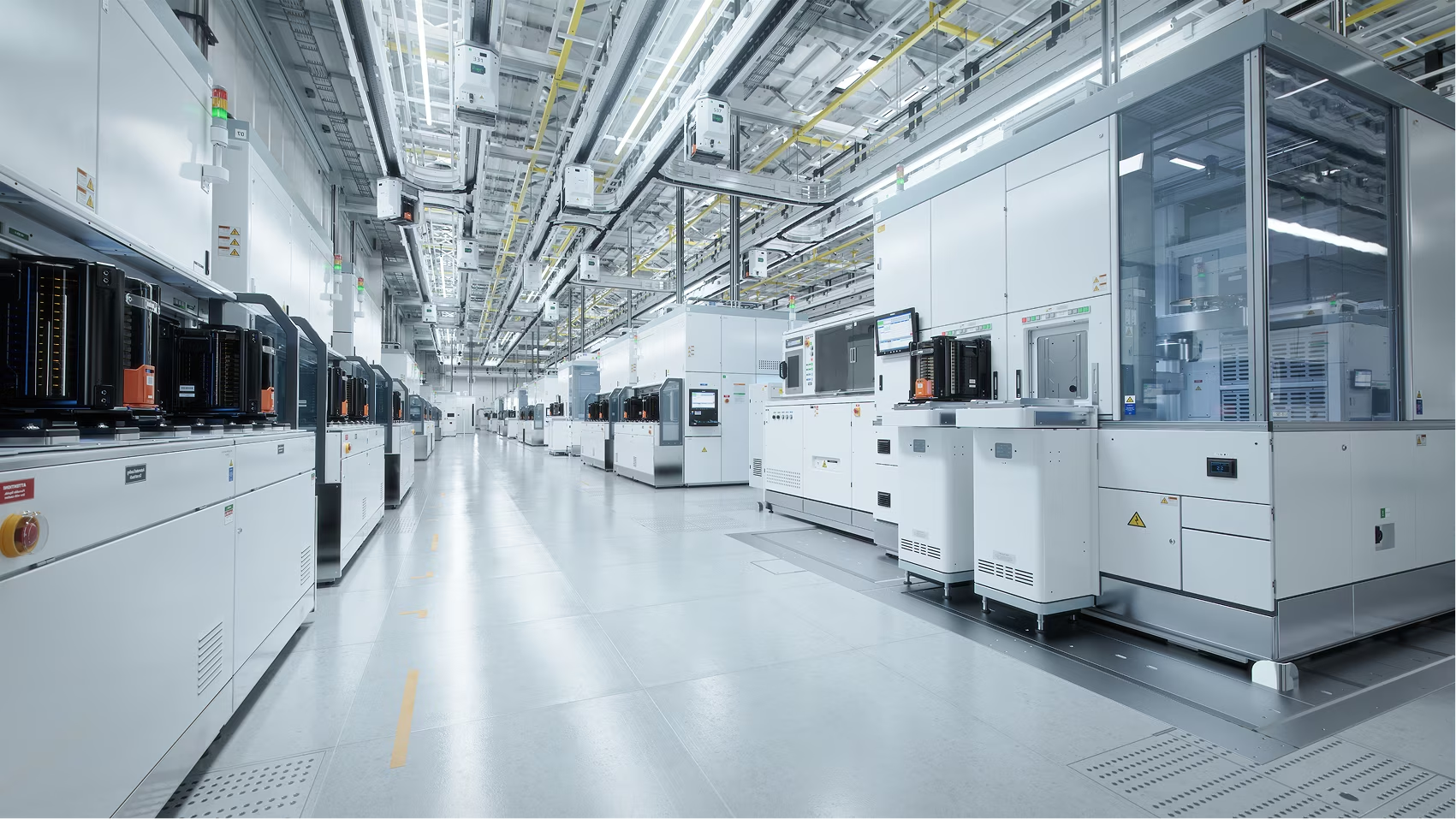
INFICON develops the measurement and control technologies that manufacturers rely on when precision is non-negotiable. Its instrumentation, sensors, and software are used to detect leaks and gases, control vacuum environments, and monitor complex manufacturing processes.
Headquartered in Bad Ragaz, Switzerland, INFICON operates across Europe, the United States, and Asia, serving industries including semiconductors, automotive and batteries, vacuum coating, and refrigeration and air conditioning.


The Challenge
INFICON’s precision products demand input from a wide range of engineering disciplines, from mechanical and electrical to manufacturing, service, and research. The earlier those perspectives come into the design, the better the chance of catching issues before they become costly to correct. But with new product development teams spread across the globe, bringing that expertise together consistently was a recurring challenge.
Solving that challenge has become increasingly important as INFICON pushes to accelerate product development and strengthen collaboration across engineering teams in the United States, Europe, and Asia.
Michael Barjaktarevic, Manager of Mechanical Engineering NPD at INFICON, and his team had traditionally relied on PowerPoint decks built from CAD screenshots, followed by live review meetings.
The review process itself was difficult to standardize. Some engineers followed established review templates closely, while others conducted reviews differently depending on their experience and approach. “The format changed depending on who was leading the design review,” Michael says. “We needed the same level of scrutiny and quality consistency on every design, regardless of who’s reviewing it.”
More importantly, reviewers often did not see the design until the meeting itself.
“What was initially scheduled as an hour design review ended up being multi-hours long because people actually started conducting the review at that time,” Michael continues. “You end up with a bottleneck because until you’ve walked through it together, nothing moves forward.”
To maintain product quality while moving faster and working more effectively across global teams, INFICON needed a design review process that made it easier to bring the right expertise into designs early, collaborate across time zones, and carry feedback through to resolution.

The Solution
INFICON began using CoLab to move design review out of slide decks and into a shared environment built around the design itself.
Reviewers can open 3D models and drawings in a browser, inspect the design, and add feedback directly against the relevant geometry. Because that work can happen asynchronously before any formal discussion, Michael and his team saw a shift in the purpose of those live meetings.
“The meeting went from ‘Let’s all look at this together’ to ‘Here’s what we found and here’s what we’re doing about it.’ We’ve collapsed time between reviews and action, which is how you accelerate product development.”
That asynchronous workflow is particularly valuable for a global engineering organization. Reviewers in different regions no longer need to find a single meeting time to inspect the design and contribute feedback.
INFICON has also moved automated checks earlier into its drawing review process. Every drawing update is now brought into CoLab, where AutoReview, an AI peer checker that understands 2D drawings and 3D parts, runs a first pass against engineering standards and checklists before an engineer reviews the results.
For Michael, that first pass is a natural fit for AI because it targets the repetitive, detail-heavy checks that are easy to miss when engineering teams are working at capacity.
“AI catches the baseline issues on the first pass, which frees our team to focus on the real engineering discussion,” Michael says. “That lets us prototype faster without sacrificing quality or rigor.”
What began as a new step in the design review process has quickly become part of the team’s regular workflow. In its first few months of using CoLab, INFICON has seen improvements not only in the amount of design feedback captured and resolved, but in how quickly teams are able to close out reviews themselves.
INFICON is also using Operator, CoLab’s AI interface for engineering data and agents, to make the standards behind its engineering processes easier to apply.
INFICON engineers work from large bodies of industry standards that can span thousands of pages, but that aren’t specific to the company’s processes. Using Operator, engineers can now pull out the requirements relevant to INFICON, including coding and tolerancing guidance; consolidate that information using CoLab’s Notebooks feature; and turn it into checklists and templates for future reviews.
The result is a more practical way to turn broad industry standards into guidance that engineers can quickly reference in their day-to-day processes. It also gives INFICON a foundation for refining internal processes, bringing junior engineers up to speed faster, and applying standards more consistently across the organization.
“We shouldn’t think of this just as design review software,” Michael says. “With CoLab’s introduction of Operator, you’re starting to build an institutional knowledge base that we can tie into future designs.”
The Impact
Since launch in March 2026, INFICON cut design review closure time from 62 days to just seven days, significantly reducing the time it takes to complete a review and move the design forward.
More feedback is being captured as well. INFICON now records more than 400 pieces of feedback each month, compared with roughly 50 when the team began using CoLab.
“We’ve gone to absolute transparency and can iterate faster.”
The team now has a record of which designs were reviewed, what feedback was raised, what decisions were made, and whether the review reached resolution.
The stakes rise considerably once a design moves downstream. Michael estimates that taking a concept through design, review, drawings, supplier sourcing, and finished parts can take 8 to 12 weeks. In his estimate, discovering a significant late-stage problem and repeating that cycle can nearly double development time.
Closing reviews faster gets designs moving sooner, but review quality matters just as much as speed. The goal is to bring the right perspectives into the design early enough to reduce unnecessary physical iterations and improve the likelihood of getting to a successful prototype in fewer passes.
INFICON has now seen that play out on one full product development program. The team achieved first-time-right, with the designs proceeding to manufacturing without additional engineering changes. The team estimates that avoiding that additional loop removed four to six weeks from that product development cycle.
“CoLab lets us capture the right feedback before we build the first prototype,” Michael says. “First-time-right isn’t just faster; it’s better margins and a more reliable product reaching our customers sooner. That’s the gold standard, and I would attribute it to our ability to better collect all feedback from the right people at the right time.”
Michael and his team are now looking at use cases beyond individual design reviews. The feedback captured through CoLab creates a record of recurring issues, engineering decisions, and lessons that can be reused rather than disappearing when the project ends.
For Michael, that growing body of engineering knowledge may be the most powerful part of what CoLab enables.
“With a tool like this, you start getting immediate results. You build up a knowledge base and can see everything in one coherent manner on each product line. Over time, that’s how product quality compounds. Our customers are buying products shaped by years of accumulated insight, not just individual engineering efforts. That’s immensely powerful.”




Better products start with better design conversations.
- Foster more meaningful design conversations by removing collaboration speedbumps
- Keep your product team and your customers informed
- Standardize your review process and track everything automatically