.jpg)
How Structure Medical Turns Speed-to-Quote into a Competitive Advantage for their OEM partners.
For more than 20 years, Structure Medical has defined precision in the manufacturing of spine, trauma, and arthroscopic medical products. Their leadership is reflected in their role as a Tier 1 supplier to the industry’s top OEMs, delivering everything from complex surgical tools to bone plates. Structure Medical focuses on staying ahead of the curve by treating the manufacturing process as a competitive advantage. They continue to raise the bar through unmatched Design for Manufacturability (DFM) expertise, rapid digital collaboration, and a relentless commitment to quality for the partners who rely on them.
The Challenge
Structure Medical has been in business for more than 20 years, with a focus on manufacturing spine, trauma and arthroscopic medical implant products. They are a Tier 1 supplier to leading medical device OEMs, supplying cutting tools, drill bits and surgical tools such as bone plates and mold cavities.
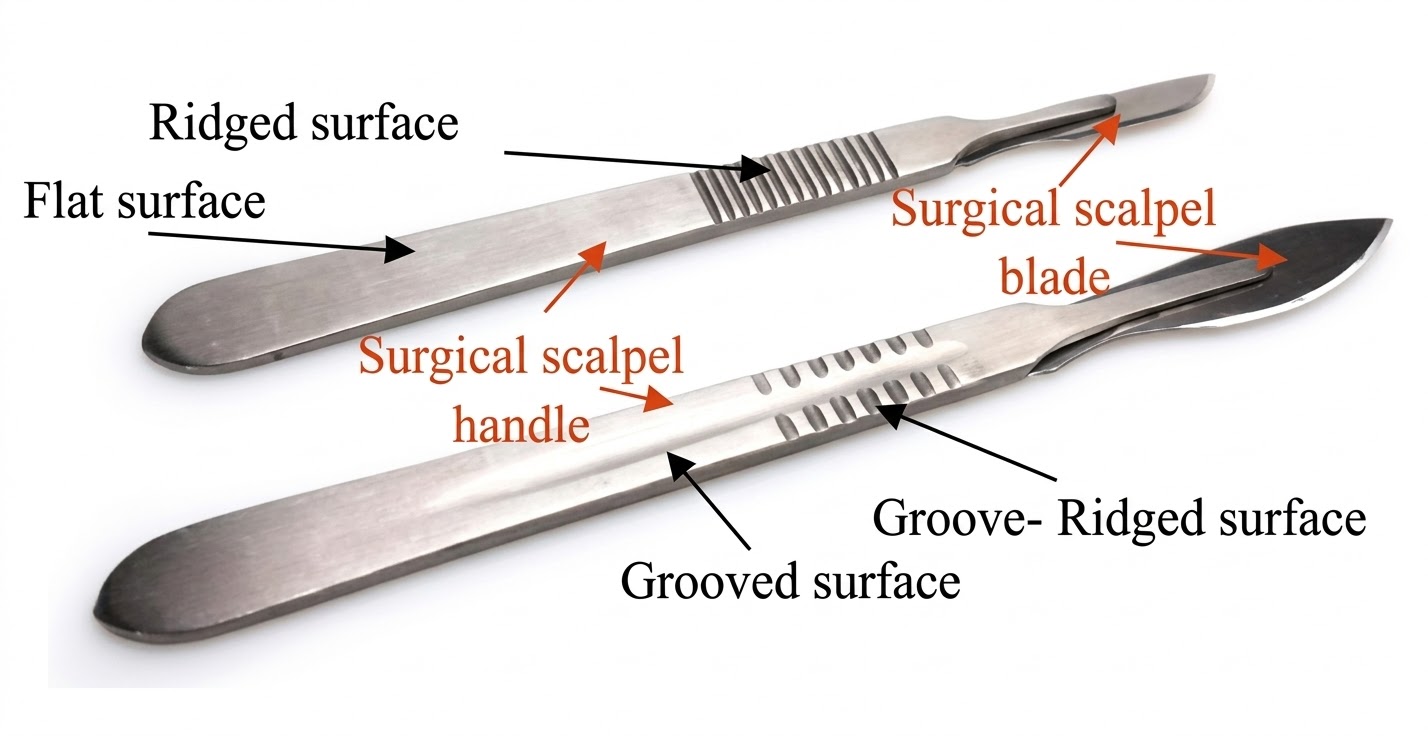
Structure Medical wins new business via RFQ processes, submitting project bids based on customer CAD and drawings. Because contract manufacturing is so competitive, a smooth, fast RFQ process can be a critical differentiator.
Structure Medical’s mentality is not just to compete. They want to be a sector leader. At all points in the RFQ process, the company aspires to be best in class.
"DFM is big for us,” explained Structure Medical Program Manager Michael C., as just one example. “A lot of times, if it's the prototyping phase, we like to provide feedback on ways to make a design more friendly to machining.”
That determination to provide the highest-quality answers competes with a clear need for speed in the bidding process:
- With every question about CAD or drawings, valuable time was lost waiting for answers.
- Engineers relied on multiple disconnected tools, including manually drawing GD&T in PDFs.
- Without notifications, engineers had no reliable way of knowing when designs required review.
- Procurement-driven communication often involved multiple stakeholders, but not always the right ones, creating “broken telephone” situations.
All of these issues can create significant drag on the company’s win rate. And even if Structure Medical did win, much of the vital feedback exchanged during the RFQ process was winding up in the Outlook trash bin. “When the time came, and we’ve won the quote, all that information was lost,” CAE Manager Brian L. says.
Most frustratingly, ongoing issues weren’t about a lack of effort or capability. The Structure Medical team had simply pushed its existing design review system as far as it could go. “It just takes so many different lines of communication to get something done,” Quality Engineer Jacob L. explains. “One of the biggest things that we've heard from customers in the past is that `you guys don't turn quotes around fast enough.’”
By the time Structure Medical had connected with CoLab, the company had identified three clear priorities.
- Accelerate quoting without sacrificing DFM quality
- Enable direct internal and external collaboration with OEM engineering teams
- Improve traceability while reducing administrative overhead
With that, CoLab and Structure Medical went to work identifying potential solutions.

The Solution
As Structure Medical adopted CoLab, four capabilities emerged as central to transforming its quoting workflow.
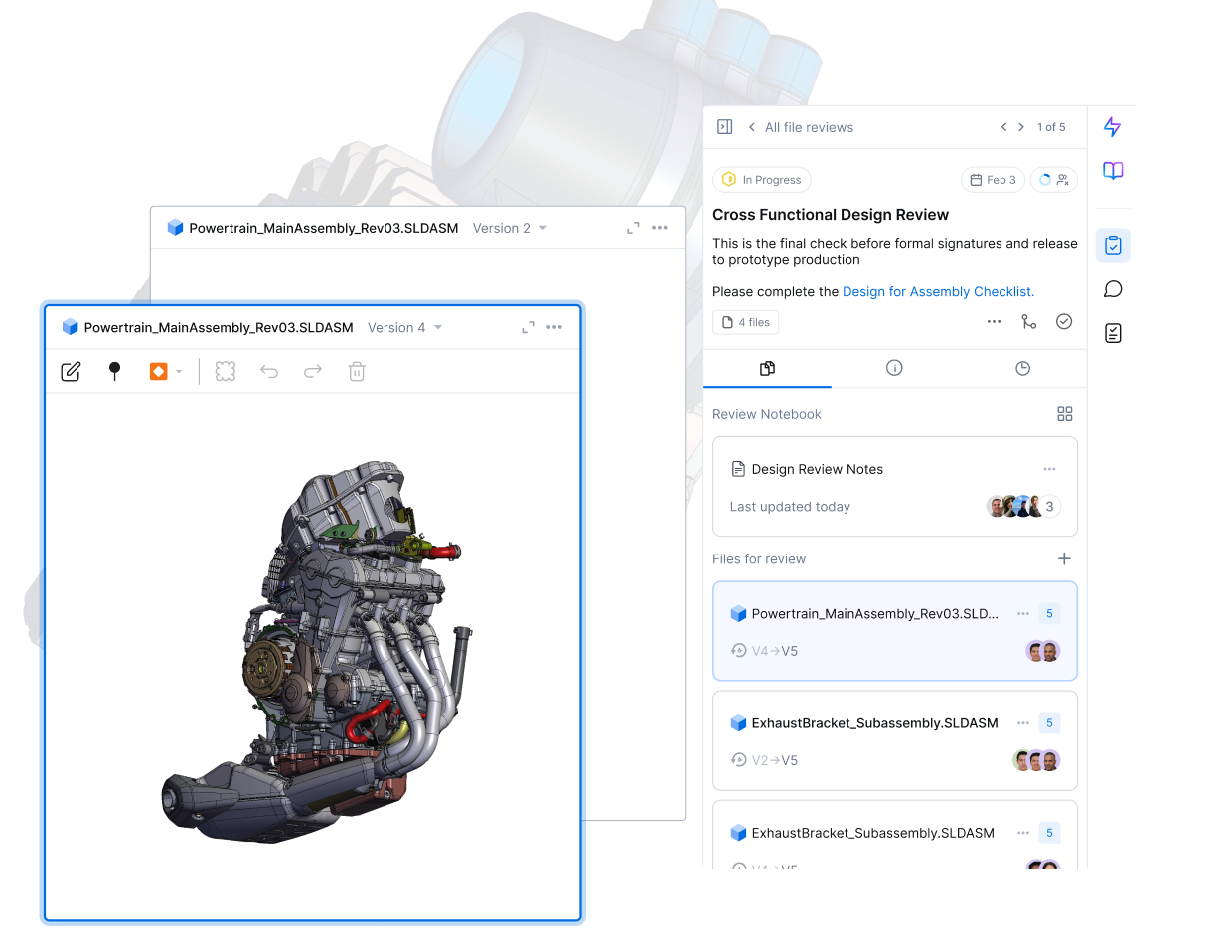
1. Creating and assigning design reviews
Structure Medical centralized design review into a single digital workflow, replacing manual and fragmented processes.
A design owner can add any number of files -- both 3D CAD and 2D drawings -- to a review, then assign reviewers to request their feedback, keeping everything in a digital format.
When the review is sent, each reviewer receives a notification in the App and in their email inbox. Clicking the link from their email brings them straight to the package of files they need to provide feedback on. All 2D and 3D files can be opened in a web browser, like Google Chrome -- reviewers don't need a CAD license or even a free CAD viewer.
Engineers at Structure Medical (and at their OEM partners) know exactly which files need their attention and when, driving accountability and faster quote turnaround.
“One challenge in the quoting phase in the past has just been getting the information to the correct party at the OEM,” Quality Engineer Jacob L. explains. “One thing that's been really nice about CoLab, is that we actually have the R&D engineers and the design engineers that are sending the quotes to us being assigned to the task. So, it's very quick: we send it out, they send a response back.”
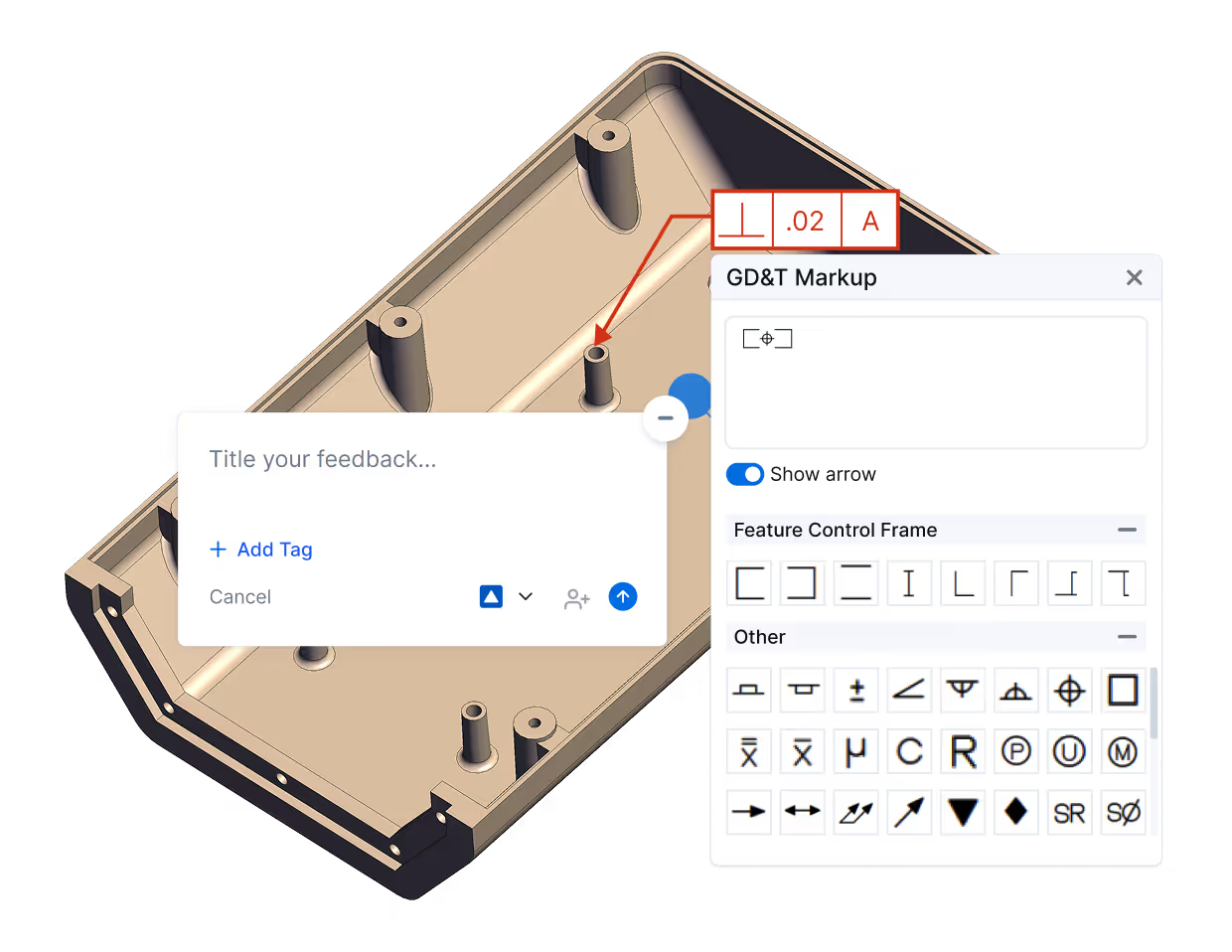
2. Built-in mark-up tools, including GD&T.
Prior to CoLab, exchanging feedback with a customer meant printing out a design, marking it up by hand, then returning a scanned copy. This often led to multiple scanned documents with different markups floating around – all representing the same design.If an attachment was lost, valuable feedback was often lost with it.
With CoLab, engineers use built in markup tools to convey feedback and clarify design intent. CoLab even supports full GD&T markup – a much needed efficiency improvement for Structure Medical’s technical staff:
“We had become really good at drawing GD&T features in Adobe. But obviously it's not to the same level as having a software that you can just throw in surface profiles, true positions and construct that GD&T however you want,” comments Jacob.
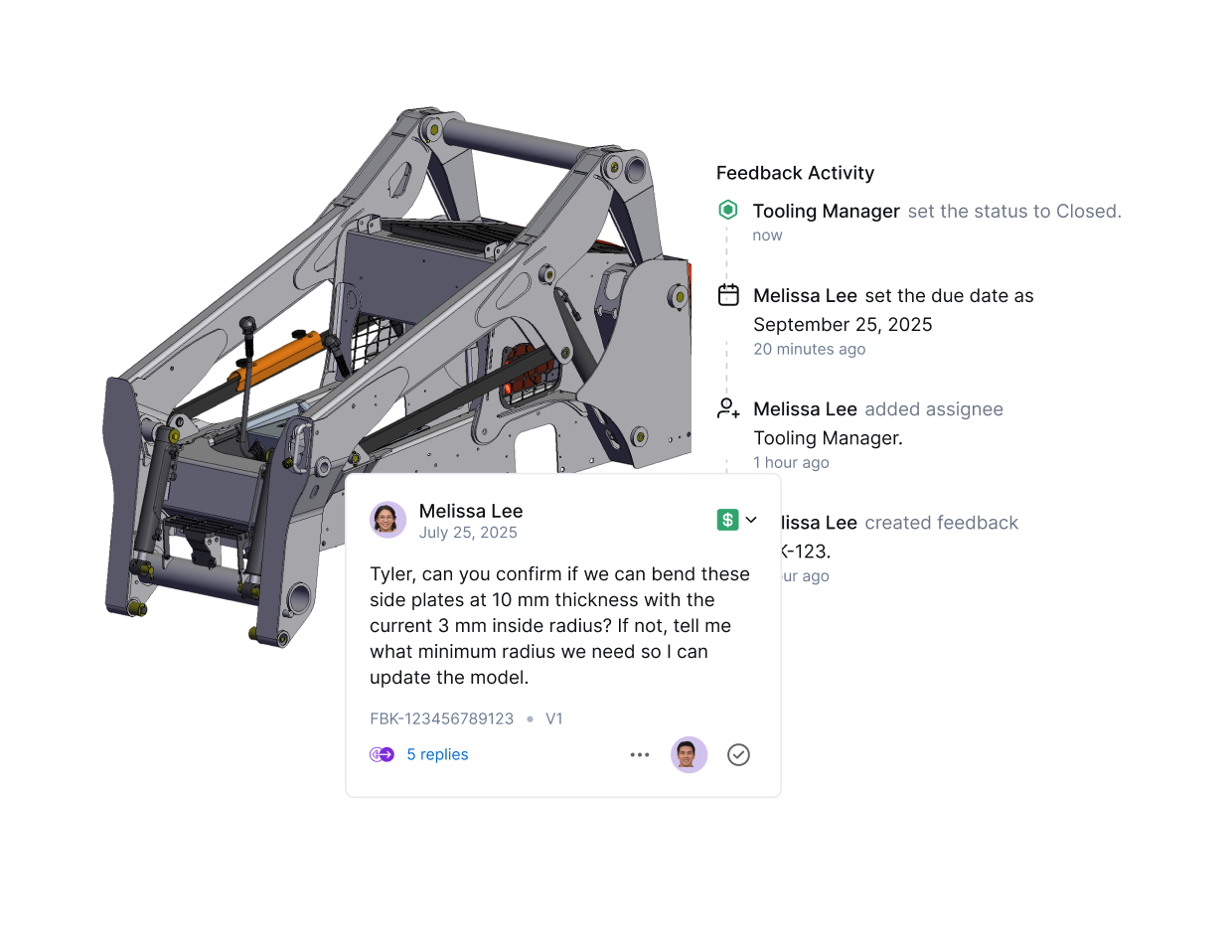
3. Assigning feedback to a specific engineer
In CoLab, each comment or markup becomes a tracked issue with an owner, status and priority. By assigning feedback to a specific owner, Structure Medical creates accountability to resolve design problems quickly. Through CoLab Portals, Structure Medical engineers collaborate directly with OEM design teams, assigning issues to the right subject matter experts rather than routing communication through procurement. This was a major breakthrough for Structure Medical, as it eliminated the games of telephone that previously slowed their ability to quote.
“I have one example specifically,” says Quality Engineer Jacob L. “We were making prototype parts and we found a cosmetic issue, a defect. I was able to take a photo on my phone, upload it to the CoLab Portal, tag the design engineer, and we had a response within five or six minutes. I mean honestly, in the past that could have taken three or three or four days.”
4. All feedback automatically tracked and saved with the file itself.
When you create a design comment, CoLab saves it with the file. You can review past comments by opening the design and panning through them in the feedback panel. Each comment will snap to a saved view state, recreating section views and model orientation intended by the reviewer. With all comments stored in one place (rather than scattered across emails and file copies) feedback is preserved and reusable.
That means it’s available for Structure Medical’s production team, whenever they win a new project: “If we have a question about the manufacturing of a part, we can share that to the Portal to our customers and get instant feedback. And then that feedback is in the production loop as well as on that quote,” explains CAE Manager Brian L.
The Impact
By adopting CoLab, Structure Medical addressed some of the root causes slowing down their quoting process. Now, they can assign internal and external reviewers to each design, consolidate all feedback in one place and eliminate back and forths that slowed them down.
"The beauty of this collaboration is how it brings the information to us rather than us having to chase it,” explains Robert Boody, CEO and President of Structure Medical.
“Whether we are reviewing an opportunity from a manufacturing or quality mindset, having that speed of access through CoLab is a significant advantage. It has changed the way we engage with our customers, allowing them to provide feedback in the moments that work for them without the constant need for scheduled meetings."
Faster quotes have created three benefits for Structure Medical:
- The company has been able to win more business
- Production teams have more time to focus on execution
- Customers reduce their own timelines
On time delivery and speed to quote have both increased. The shortened bid time has also led to more time for engineers to do actual quality engineering.
"By the time someone comes out to us for a quote, they already have dates and launches set in their mind. A lot of times it's coming down to the wire and we’re almost under the gun. So the less time it takes for quoting, the more time we have for production. Getting a quote out quickly gives us more time to jump on actually making the product," says Michael Cole, Program Manager at Structure Medical.
Gabe Rivera is Structure Medical’s Director of Customer Relations. He explains that all sides have ended up winning: Both Structure Medical and the OEMs they are supporting, with CoLab in the middle.
"In the contract manufacturing space, every project that you're taking on is a new project – and it takes time to do that,” Rivera explains. “Designs have to be sent to manufacturers to be validated and that takes time.”
OEMs are often trying to balance cost with quality, evaluating multiple suppliers for every sourced component. A smooth quoting process means that customers can qualify suppliers that meet their cost and quality requirements more quickly. And that has helped make Structure Medical the first choice as a supplier.
“That speed is advantageous to us. If we can turn around a quote in 24 hours and it takes somebody else three weeks, then that's three weeks’ time that you’re banking for the OEM,” Rivera sums up.
Lastly, Structure Medical now operates with a more modern, digital approach that customers respect. “It puts forward a very professional representation of the company. Our goal is to remove friction from every customer interaction.” IT Director David Mowery said. “By centralizing design collaboration in one system, we’ve created a faster, more accountable, and more transparent process. That level of digital maturity builds confidence with our OEM partners.”